Search This Blog

Powered By Blogger

Tuesday, March 29, 2011

La Nina, Costa Rican coffee, street water saves, and Victorian Kitchen Gardens II


We've been talking about how cold it is along our Central Coast, but just the opposite effect is occurring in Costa Rica.


 Their coffee production has dropped 25% because of high temperatures for the last 6 years. Coffee farmers are having to give up growing coffee unless they can move up to the higher altitudes (lower temperatures) that the coffee prefers. (See http://www.latimes.com/business/la-fi-coffee-20110323,0,2770618.story. )


Leigh Adams' gutter diversions
On a more cheerful note, somebody has figured out a way to divert  run-off water and save it to feed the ground water. Not sure the method used is very practical as it involves getting permission from your city to make drainage holes in the curb.This does not strike me as something cities would be enthusiastic about...

  However, it's an entertaining article and it seems, strangely to have  almost vanished from the LA Times archives . (The article ran March 12, but it is archived under March 4, 2011.) For you conspiracy theorists there there.....Maybe the LA Times doesn't want us to try this at home?  Emily Green wrote the article  which it talks about a garden in Altadena full of new fruit trees, all of which are being watered with diverted rain water from the gutters.http://latimesblogs.latimes.com/home_blog/2011/03/leigh-adams-john-lyons.html. The gardener created a swale to absorb the street water.

The latest news along our Central Coast is we are officially out of drought mode. First time in many years. Do you think the water rates will drop?  Noooooo...
Forcing pots
Meanwhile, back at the vegetable garden,our Victorians had brought forcing and blanching to high art. The handsome terra cotta pots in the picture were used for forcing  rhubarb, blanching celery  or asparagus. The gardeners also simply wrapped the plant to be blanched in straw and tied it with a raffia ribbon. Lacking the pots, we could do that. To blanch celery the kitchen gardeners also planted celery in a trench and slowly filled it in as the plants grew. (Can't see why celery shouldn't be green, but chacun son gout.)

A modern methods the Victorians  would have loved are :

row covers

  Row covers--  protect the starts from cold, wind and insects. These let in 75% of the available light. 

For smaller gardens and impatient gardeners the water wall will radiate heat to the plant at night. This kind of booster was not necessary in years past, but  we are ready to try it on  Early Girl tomatoes and  Japanese eggplant eggplant, remembering if the soil hasn't reached 65 degrees----- it might not do much good. It would probably work if it stops raining.
water wall
Last is the mulch to heat the ground around the plants-- lets through water and holds the radiant heat of the sun. Several kinds are on the market:
red or black plastic, or biodegradable. Biodegradable makes the most sense.
Biodegradable mulch
 Note: all these things are available at Territorial Seed Co.

Next: Victorian Kitchen Gardens III ( Grapevines at Blenheim,)  Founding Gardeners and Rethinking California Lawns

Monday, March 14, 2011

La Nina and Victorian Kitchen Gardens (First Installment)


2011   Here’s yet another take on why it is so cold in SoCal this year. It’s basically all from La Nina---global warming is occurring, but not along our California coasts. There's an upwelling of very cold water from the deeps of  the Pacific, which means colder than usual  (by 10 degrees) weather for us.

Well, fine. What can we do about it? 

The people who mastered the art of gardening in a miserable cold climate might give us some ideas. The high Victorians brought kitchen gardening to incredible production. On a typical large estate, 14 people tended the gardens, the household staff numbered 20 or better, house guests up to 30 with their attendant maids and valets were expected on week-ends and the family --and they had big families with various poor relations hanging out in the garrets. 14+20+30+30+10 for the family = 104 people who had to be fed 3 meals a day---and no supermarkets.

The long awaited Victorian Kitchen Garden miniseries (Acorn) having arrived by Royal Mail (6 weeks late),  having acquired its correct DVD player (Phillips), is an education in outwitting cold, grey, rainy weather.

The first weapon was the walled garden. The walls might enclose 6 acres, and be over 12 feet high at some of the great houses like the one at Dunmore in Falkirk, Scotland.


the Dunmore Pineapple

 Falkirk is at the same latitude as Moscow (okay, it is warmed by the Gulf Stream, but still…these gardeners managed to grow peaches, grapes and pineapples.) Lots of them. A fruit house might contain one and 1/2 tons of fruit by the end of the harvest.
The walls were usually brick—sometimes containing fireplaces, so the wall acted as a giant radiator.

Miles of glass houses, warmed by hot water piped through them, produced tropical fruits (pineapples*), melons all year round, peaches, nectarines and grapes--- in enormous quantities for the enormous households.


Glasshouses on North Wall

The Victorian Stable

 Unless you are a hedge fund manager, you probably aren’t going to rush out and set up a heated greenhouse. (If you do, be sure it is solar powered.) Actually the most used solution was very simple—manure.

Well housed
This was still the era of the horse and a large estate produced lots of manure ---and the Victorian gardeners used  tons to great effect to create hot beds which raised the soil temperature . This makes all the difference to plants.   If you live on a, cattle or llama ranch, or ostrich farm, you've got it made.  Pig manure is the cream de la creme but we can't all be lucky.


Cloche from Monticello, Jefferson's garden

A hotbed or forcing bed, heated with a lot of manure can raise the soil temperature by as much as 4 degrees. Or you can use a cloche  or bell.

Modern plastic cloches
  There is nothing wrong with a large (2 gal. or better) plastic bottle with the  top cut off (easy to do with a hot knife) although not as romantic looking, your tomato plants won’t care.
More on Victorian Kitchen Gardens in Installment Two .  Coming soon. 

*My well educated readers already know a pineapple is a bromeliad.

Monday, February 28, 2011

Icelandic Volcanoes and SoCal cold weather

I really got myself into trouble with this topic. How can volcanoes in the Atlantic Ocean cause ash fall that affects the weather along the Pacific Coast?

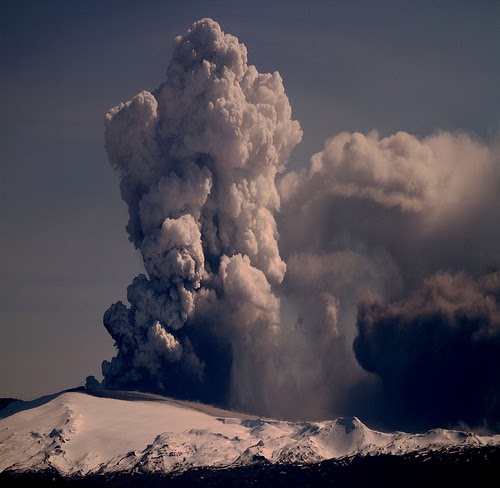
Eruption of Eyjafjallajökull in Iceland - April 2010. This is the one that tied Europe in knots for two weeks.

Ocean gyres

Map of the major gyres that affect the weather by their temperature, and here’s the map of earth from the N. pole
Earth from N. Pole
Here are the ocean currents . Notice the California current. The five major coastal currents are parts of the global ocean gyre system and" as such, these currents are driven by wind and deflected by landmass"(W)


Here’s a picture of the ash pattern from the volcano which brought Europe to a standstill last April. This is the smaller of two volcanoes which have a pattern of erupting about every 300 years causing very cold weather. The larger volcano is expected to erupt anytime….
“Eruptions continue at Kirishima volcano, Japan. Since the eruption began in January, an estimated 80 million tons of ash have fallen over a wide area..” (2/5/2011) .. Ash emissions reached a height of 25,000 ft…” from another Japanese volcano in January 2011.  John Seach. volcanolive.com (source) Eruptions from Krakatau volcano, Indonesia forced the evacuation of tens of thousands residents on 11th January 2011. “
 By now it may be beginning to occur to you, as it did to me, that our grey, cold (10 degrees officially) summer might have something to do with volcanic ash…. Since the Pacific is ringed with volcanoes, many of them in eruption in January and February of 2011.
 
Pacific
. (According to John Search- at least 6 have erupted in the Pacific. This isn’t even counting  Mt. Etna which is erupting in Italy.

Last but perhaps the most important piece of the puzzle is Maunder minimum which is a pattern of sunspots associated with cold weather. It is a periodic phenomenon that has been tracked since 1645. 
 The Maunder minimum is the name given to a period of extreme solar inactivity that occurred between 1645 and 1710. Of particular interest is that this period of inactivity corresponds closely to one of the coldest periods of the so-called "Little Ice Age" in Europe, a time of long, cold winters that caused severe hardships in the pre-industrial revolution world….”(W) ..In 1991, a pair of Danish meteorologists published a paper in which they pointed out a remarkably strong correlation between the length of the solar activity cycle and the global mean temperature in the northern hemisphere. …"
Meanwhile, back at the ranch….. its getting colder along our Central Coast helped along by something besides ash blocking the sunlight and sunspots. It is called Artic Ocsillation. “When the AO index is negative there tends to be high pressure in the polar region, weaker zonal winds, and greater movement of frigid polar air into middle latitudes." (W) Translation, all those Alaskan cold fronts that having been dumping unusual amounts of rain and low temperatures on SoCal are caused by AO . The Kurile current, a cold subarctic ocean current isn’t helping either.
The good news is all of our stone fruits will be happy campers. Just planted two cherry trees!

 The lime tree lost his leaves, as usual, but has grown them back again. The ground has warmed up despite the rain and cold—planted out starts of scarlet runner beans today that were clamoring to get in the ground. The ground was much warmer in the raised beds than I would have expected. We are still getting bell peppers from last summer’s pepper plants. Go figure!


Note: I'm indebted to Tench Tilghman, president of More Competency, for research suggestions. Mistakes are my own!