

This is epiphyllum blooming season in So Cal. Always forget how spectacular they are. This year the pink and coral shades are blooming now on the place, and reds are in the nurseries.
Epi’s bloom through the spring and into summer. My experience is that the bloom times are fairly unpredictable, but my plants are from plants that were 50 years old when the cuttings, unnamed, were made. Modern hybrids are possibly more reliable?
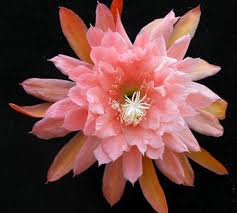
America's Sweetheart hybrid
In innocence (polite term for ignorance) thought I could easily give a description of the various types of epi’s. Wrong. To generalize madly---modern epi’s are the result of hybridization with day blooming types, hyliocerius and night blooming cereus.( The best account of the epiphyllum species is probably the website Got Epi’s ( http://gotepis.com/drupal/node/4.--- ) Highly recommended.
Meanwhile the word epiphyllum comes from Greek and means “upon the leaf” which is where the blooms occur.
Meanwhile the word epiphyllum comes from Greek and means “upon the leaf” which is where the blooms occur.

e. akermanii
Though hard to classify neatly, most epiphyllum are easy to grow in So Cal--they like dappled shade, bloom best growing in pots (mimicking the tree forks they like in their natural state), a bit of water, but not too much--every 10 days in the summer is good--- a potting soil for terrestial orchids works . Or use a formula especially for epis consisting of potting soil, bark, a bit of perlite. In other words-rich but fast draining. Every grower has his own perfect recipe.

Epi Rose Samoa
Generally grown from cuttings--- hopefully find a friend for free ones--- or a vendor on the Internet. Actually the free ones might come into bloom faster, if you can score an old leaf. Epi's bloom on older leaves. Vendors generally supply newer leaves, which are going to take maybe 3 years to come into flower.
Generally grown from cuttings--- hopefully find a friend for free ones--- or a vendor on the Internet. Actually the free ones might come into bloom faster, if you can score an old leaf. Epi's bloom on older leaves. Vendors generally supply newer leaves, which are going to take maybe 3 years to come into flower.
Epis are first cousins to Dragon Fruit ( a hyliocereus) (see earlier blog August 22 , 2011) . DF's take 2-3 years to begin flowering and fruiting. All hybrid epi's have hyliocerues in their parentage, otherwise they'd bloom only at night. The colored day blooming epi's have night blooming cereus in their parentage if they are fragrant. ( Surmise! This is tricky stuff. ) Here is the Night Blooming Cereus in one of the most goth illustrations around:

From Dr. Robert John Thorton’s The Temple of Flora. 1799.**
Though hard to see in this print, in the background there's a clock tower pointing to midnight, emphasizing that the cereus flower lasts only for one night. It is very scented.
Caveat emptor-- many of the plants called night blooming cereus aren't. They are epiphyllum oxypetallum which is a glorious and dazzling plant in it's own right.

Queen of the Night (Epiphyllum Oxypetalum)
The leaves of the Queen are flat, epi leaves.Night blooming cereus has funny, spiny,gangling round leaves.( see 1799 illustration above)

Here is Night Blooming Cereus climbing a palm tree


Some Night blooming cereus are temperamental along the So Cal coast. (Epi's aren't) Had one cereus that grew and lived for many years but never bloomed.Triangular leaf. Acanthocereus tetragonus. Too dry for it at 1200 feet up in the foothills.Acanthocereus tetragonust is a native of S. Florida, needs a more humid, tropical climate than our semi-arid foothills.Might grow along the coast in a sheltered hot spot?

This one is also called Barbed Wire plant
Another cereus that blooms profusely along the coast in So Cal is c. peruvianus, which also bears fruit (pitahaya) . It blooms at night (of course) is scented and grows fast. Mine used to bloom in July. Gave it away and planted an apple tree instead.( Like apples better than pitahaya.)

c.peruvianus
Bet you're glad we got that sorted out.....
The weather this spring has swung so madly from hot to cold, accompanied by late rains it’s no wonder the epis are in major survival mode.” If the plant is very healthy it doesn't feel threatened and won't bloom"* We like to think plants bloom and fruit trees bare when they are happy. This is—to an extent, true. But they also react to stress by blooming more and setting more fruit to ensure their survival, much as the human birth rate rises in times of war.

St. Louis Spring hybrid

See even more epi's having a survival party at :
EPICON XIII
The 13th International Epiphyllum Convention May 26 & 27, 2012
http://www.sandiegoepi.com/epi/epicon_xiii
Notes
St. Louis Spring hybrid

Stormy Weather
This one is a favorite-tempramental bloomer- but worth the wait for its fushia interior and scarlet exterior. The plant is about 20 years old. Blooms best if left in at least 1/2 day sun along the coast. Move into shade once blooms are set.See even more epi's having a survival party at :
EPICON XIII
The 13th International Epiphyllum Convention May 26 & 27, 2012
http://www.sandiegoepi.com/epi/epicon_xiii
* quote from Got Epi's
** This has recently been re- published in several editions


 . )
. )


