Search This Blog

Powered By Blogger

Thursday, July 19, 2012

The Botanical Collages of Mary Delany

Note: all these collages are available at the British Museumhttp://www.britishmuseum.org/research/.
These exact and arresting images were created in the 18th c. by a little old lady.  (She was 72 when she started the project) out of paper she painted then cut and pasted to make a collage. Not only was she a remarkable artist she was altogether a remarkable human being.  There’s something about botany…


Mary Delaney was born into a noble but impoverished English family  in the 18th c.--- the family had made the wrong choice in backing the successor to King Charles II.[i] 


The Merry Monarch had left his younger brother as his heir. Mary’s family felt it was safest to back the designated heir, James, who was deposed.. And did so to their financial ruin since all offices and preferments  flowed from the king. Disaster.

 Mary’s father lost his income from offices he had occupied under Charles II. The family lost it’s footing at court, was forced to retire to the country . 


Mary at 6  was sent to live with an aunt in London who provided her with an excellent education, including cut work in paper, embroidery, water color painting, music, etiquette, dancing lessons--- all to make Mary suitable for a position at court. Mary grew up lively, spirited and artistically talented. She designed and embroidered striking and fashionable clothes for court, and went on hoping for a position as a Lady  in Waiting. This never materialized.


As it became clear Mary was not going to be able to obtain a position at court, the next move the family decided on was to marry her off to provide for her, and generally improve the family position. (This was the common practice. In the 18thc marriage for love was not a central concern, Georgette Heyer to the contrary.)


Another  of the family’s more  unfortunate decisions was to marry Mary at 19 to a 60 year old drunkard—he was rich, but his estates were in Cornwall, far from the court where Mary longed to be. However, if his estates passed to Mary, her male relatives would get control of his money.** which apparently  was her older brother’s plan all along. ( The older brother was legal “head of the family” even though he consistently did extremely stupid things ….)


And then the old drunken husband  died---- it didn’t do the family a bit of good as he neglected to redo his will in Mary’s favor. Foiled again!


 This misfortune doubtless rankled the brother, but turned out to be good fortune for Mary. She was left a modest but sufficient competence to return to London and the court. Mary had her own house and an independent life as an attractive and accomplished young widow. She reveled in it. Mary flirted with Lord Baltimore and was rather miffed that he never proposed. Missed being an American by a whisker....


                         Mary and some friends


She did not re-marry until she was in her 40’s and then for love to a man her family though far beneath her.(He was an Irish clergyman.)
She lived an extremely happy life in Ireland with her husband until he died when she was in her late 60’s.

These astonishing collages are how she dealt with her widowhood and grief, drawing on the paper cutting skills  and watercolor techniques  she had learned at her aunt’s behest  and exercised all her life.Though she never made it to the Court she  was part of a circle of Enlightenment intellectuals, musicians (Handel) and scientists, creating her own  “court”.* 


[i]James of York, the heir to Chas II, was an ardent, fanatical Roman Catholic who reminded the English all too  vividly of the Catholic queen, Bloody Mary and the burning of Protestants at Smithfield during her reign.. So,  Parliament rejected James and chose instead  the Protestant  Mary  and her husband William of Orange to rule.(Mary was a Protestant despite being another Stuart and James’ daughter. Go figure)

 If interested in this period, the BBC mini-series The First Churchills  lays it all out in an entertaining fashion!

2 Actually she lived 6 months of the years with the Duchess of Portsmouth, a great friend, whose magnificent conservatory at Bulstrode provided many of the “models” for the flower mosaics.


3 not until the 1850’s with the passage of the Married Woman’s Property Act did widows retain monetary control.


Books about Mary:
Mrs. Delany Her Life and her Flowers  by Ruth Hayden, British Museum Press


A Paper Garden by Molly Peacock, Penguin Books


And not to be overlooked is Mrs. Delaney and her Circle by Mark Laird  and Alicia Roberts. (Yale Center for British Art). I’m waiting for the paperback!


Had to change the template of the blog and give up the old background---alas!
Progress, whether we like it or not!


Thursday, June 28, 2012

Hydrangea, Astromeria - June bloom So Cal

                                  Hydrangea macrophylla
                                    (mophead)
Hydrangea (Hortensia) is not generally considered a water-saver. However in the cloud forest along the So Cal coast, hydrangeas---hydrangea macrophylla---in old gardens (along with Belle of Portugal roses) have survived for 50 years or better, planted as foundation plantings with an eastern (morning sun) exposure without extra water. In this garden 6 hydrangeas grown from cuttings from an old garden in the neighborhood, survive handily, bloom copiously, and manage on a soaker hose every 3 weeks  to keep them blooming  in summer. Hortensia survive with rainwater once the roots are well-established (thanks to the cloud cover),  losing only leaves if drought stricken. The plants  survive.

Our mop heads  came to the Americas via the Azores  but originate in Asia. There about 110 different kinds--- mopheads and lace caps being the most familiar around here.

                          Hydrangea macrophylla
                                 (lacecap)
The small potted plants from the grocery store will grow along the coast. A lot of websites airily aver you can turn your pink hydrangea to blue or purple by adding aluminum sulphate to the soil. This will work on the East Coast (or anywhere the soil is naturally acid.) It won't work around here if you plant your hydrangea in the ground, because our alkaline soil prevents the aluminum sulphate from working.


 If you must have blue--and it is lovely--put the plant in a pot of acid soil, then add the aluminum sulphate in the fall. However, you no longer have a drought resistant plant--- you have to water all the time---to be green, better to enjoy your hydrangeas pink.


                                           Astromeria aurea Golden Lily of the Incas


Astromeria, also called Peruvian Lily is another tough plant, drought resistant, blooming naturally after the winter rains, blooming much longer with an occasional soaking. Why Peruvian when actually our plants are hybrids of a plant from the mountains of Chile and another from the highlands  of Brazil ? To Europeans of the 18th c. all of  Spanish S. America was called "Peru". 


Though looking somewhat like a lily, it isn't. It's a rhizomous plant with water storing tubers, not unlike a dahlia. Our hybrids, developed mostly in England and Holland, are a cross between the winter blooming plant from Chile and the summer blooming plant from Brazil. It now comes in about 10 colors  and new colors are being hybridized. It's a long lasting cut flower--one of the best.


Atromeria bloom spring through summer. The trick to keep the flowers coming is to pull the flower off, not cut it. It then hastens to produce another flower stalk.

The seeds of astromeria were brought back to Linneus by a student of his, Claus von Astroemer who went on one of the earliest voyages of botanizing in S. America in 1753.* Linneus, no slouch at "branding" named the pretty Golden Lily of the Incas for the very wealthy father of Claus Astroemer. ("Keep those cards and letters coming...") 
                                                      Linneus dressed as a Laplander


Note:


 Claus actually described the Humboldt current 50 years before Humboldt. He was quite an adventurous fellow though you might not think so to look at him. Became a Baron, started a botanical garden at Gotheburg and has a perfect right to look pleased with himself.


Claus von Astroemer

Friday, June 22, 2012

Jacaranda, Poinciana, Golden Trumpet Tree--Blooming for Summer Solstice


These trees, tropical --and sub-tropical are the Cirque de Soleil of the summer solstice.


This tree is mysteriously absent from our Central Coast. This is peculiar as Poinciana tolerates temperatures to 20° and could, in theory be grown in suitable micro climates along the coast from San Diego to Point Conception.


                                                                   Golden Trumpet Tree
The Brazilian Golden Trumpet tree grows without problems along our coast as far north as Santa Barbara. It’s doesn’t develop into a luxurious golden canopy for a number of years unless it is planted in a sheltered hot spot , but even as a smaller tree it is worth growing.
All these trees are related, all members of the Bignonia  family  which was established early ( 17th c.) in the history of western botany to honor a great patron of botanists- Jean-Paul Bignon
          

 Bignon, through his influence with the king (Louis XIV) was able to get the necessary royal financing--- without which nothing got done in the France of Louis le Grande
.As plants,, many of the Bignonias are attention getters and  few of them are unassuming  (c.f  Scarlet Trumpet vine, also flourishing along the So Cal coast)


Unkind people might find the Bignonias a touch gaudy as his enemies found Jean-Paul. But for us,  Bignon gets added to the  list  of splendid patrons who had the  foresight  to support plant explorations. Even if these patrons,(like present day ethno-biologists combing the Amazon forests)  were after commercial results---hoping for something spectacular*

 Bignon’s protégé, De Tournefort was a serious scientist  (you can see by looking at him) who first sorted out the concept of genus. A physician as well as a botanist,  De Tournefort . was nearly  forced into the priesthood. Freed from this fate by his father’s death, De Tournefort to was  able to pursue his true passion--- botany.  (My perceptive readers have already figured out , that botany was the glamour science of the 16th, 17th and 18th centuries.)
                                         
De Tournefort’s efforts were rewarded with a professorship at the Jardin des Plantes. A plant explorer himself he encouraged others also  and wrote Elements de botanique (1694). Eventually, even  got  a 
street in Paris named for him.

                                                                             Rue Tourneforte
 Bignonias are a guy’s best friend….they won’t lose their shape.. Jacarandas are tough trees and often self-sow in So Cal. Their flower fall of purple rain  is exasperating to some, poetic to others. They are ,obviously, easy to grow. Jacaranda grows in well drained soil and tolerates drought. Water saver!

The  red canopied Royal Poinciana (Delonix regia) is equally thrifty  where it’s warm enough for it. (Zones 9-10).  
Mystified by the absence of Poincianas along the Central Coast, decided to grow my own. Perhaps the mystery is solved. When seeds arrived the package announced “ seeds may take several months to sprout at 75°-85°.(!)
 In the tropics those temperatures occur naturally; Poinciana grows like a weed. The Poinciana tree has nitrogen-fixating and soil-improving properties  Surprisingly, it is a legume. Native  to Madagascar, an entrepôt for the slave trade; Poinciana  travelled the Middle Passage to the West Indies .

In So Cal, the seeds need help to propagate quickly. See http://www.desert-tropicals.com/Plants/Fabaceae/Delonix_regia.html for good directions  Basically, you soak seeds in very hot water 48 hours  before planting. Hopefully,  shouldn't take months to sprout them—stay tuned….

Update August 27, 2012- Poinciana seeds from Rare seeds arrived within a few days and were subjected to the very hot water treatment, soaked in 1/4 of an inch of water until they spouted on 8/26/12/. Basically it took 2 months. Suspect it could be done in less time if the process were begun in August, as tropicals tend to sprout most quickly in late summer/early fall, getting ready for the rainy season.

                                                 photo from Trade Winds Fruit
 The Golden Trumpet tree Tabebuia chrysotrichaThis tree is a favorite of the University of Florida dept. of botany at http://hort.ufl.edu/database/documents/pdf/tree_fact_sheets/tabchra.pdf  .   UFL can’t understand why more Golden Trumpets aren’t planted as  it’s a proved to be  happy urban tree that isn’t a water hog
 Grows to 25 feet.  Flowers appear as do the jacaranda flowers  while trees are leafless.. Tolerates temperatures into mid 20's F and looks best with occasional to regular watering in warm months plants flower best when not overwatered. [i]

Three colorful  canopies  of flowers with romantic pasts……… and water savers every one.


[i] Information from San Marcos Growers

  Blooger is knee-deep in technical difficulties having changed  browsers! Arghhh.....

Notes:

*All hoped to find another  golden egg such as  the Spanish found in the cochineal trade based on 1,000 years of Aztec cactus farming .See A Perfect Red by Amy Butler Greenfield

For those who like their details up to date—Jacaranda is now a genus of its own. A lot of fine tuning goes on in the world of botany.  Bignonia is now a “family”.  Golden trumpet has also been assigned into 2 catergories. 


Thursday, May 24, 2012

Blooming now Echium candicans of unsung hero , Francis Masson

                         Echium candicans- Pride of Madeira

This plant is one more denizen of the cloud forest that has successfully adapted to the So Cal coast. The ones in the picture are a rather sedate size, but given their head echium candicans can and will grow to 6 feet. As the name suggests they hale from the island of Madeira off the coast of Africa


 Their native habitat is windswept, fog wrapped, dry cliffs. This means--- Pride of Madeira is an unsurpassed plant for us  to cover steep, difficult slopes with an exuberance of blue steeples in spring and early summer. Once established ( some water the first year) all they'll need is the pruning shears there after. 

 Bees, butterflies and birds love them.
                         Echium candicans  combined with aloes

Hummingbirds particularly would love this combination as  aloe arborescens is one of their favorite plants.

 Pride of Madeira is  an almost perfect 10-- drought resistant, home for butterflies, bees love it (and the honey is reputed to be very good). It is a bird refuge. The only thing it isn't, since it isn't a succulent--- is fire retardant. However if combined with aloes as above, it becomes lots  less flammable.


Echium candicans can be grown from softwood cuttings,  or seeds or a 5 gal. plant from the nursery. They are gangly babies, showing little promise of their swan-like conversion into a mass of spectacular blue steeples.

 Echium candicans has a first cousin called Tower of Jewels Echium wildpretii a native of Teneriffe very similar to candicans but bigger and redder.


                                    Echium wildpretti- Tower of Jewels

It is classified as a biennial, like parsley, but either this is not true in So Cal, or it self- sows so readily you never notice its biennial nature? (Try saying self-sows so readily a few times...). Anyhow--the bees think it is simply superior:

                                          
 Tower of Jewels close-up with bee (W)
(The Canary Islands and Madeira are very close neighbors off the African coast. Madeira lies slightly to the west of the Canaries at 32.6511° N, 16.9097° W.)
These tough beauties were sent to Kew Gardens in 1777 and were collected by one of the more unsung heroes of the plant world, Francis Masson.

Masson was a Scot, as were many of the great English gardeners. He was the first of the plant hunters from Kew, hired by Joseph Banks* to actually do the heavy lifting of collecting, nurturing and transporting the new species found  on Captain Cook's second circumnavigation  of the globe aboard the Resolution.
                                                                                                                                                  

 As a gardener/botanist Masson slept and ate with the crew since he did not rank as a "gentleman" in the English caste system. That means a hammock in a 4 foot space.

Masson was dropped off in S. Africa where he spent 2 years collecting,( while Cook proceeded to his death in Hawaii.)  Masson collected over 1700  new species for Kew, 500 in S. Africa alone. 

                        Protea-  Photo ©  by Martin Heigen 

 In 1776 Masson went to Madeira , the Canaries and the Azores  collecting the echiums, sending them back to Kew. His Account of the island of St Miguel”  was published in 1778 in the “Philosophical Transactions of the Royal Society of London.

A potted palm ( Encephalartos altensteiniiEastern Cape Giant Cyclad   he collected and cared for is still alive at Kew in the Palm House-- the oldest potted plant in the world. It can be seen in the background  this painting of Masson at Kew.
                                               

Masson was recognized by his contemporaries as the prodigious botanist he was and was made a Fellow of the Linnean Society -  a most unusual honor for a  "gardener".

" Banks once more persuaded" Masson to go collecting--this time in Canada. Masson  spent the next seven years collecting plants in the Great Lakes area of Canada. He died in Montreal.

The genus Massonia is named after Masson. A most unassuming genus.
                          Massonia echinata (like a hedgehog)
 Every time you see an agapantha displaying its blue fireworks, or a  Bird of Paradise flaunting itself, a gazania, a Tower of Jewels, a Pride of Madeira--bless Francis Masson. 
Note: see the Kew website and one called  Unknown Scotland. (Masson was born in Aberdeen and the Scots are rightly proud of him).
*More about Banks in a later blog. He's certainly a hero, but hardly an unknown.

Thursday, May 3, 2012

Epiphyllum blooming season in SoCal

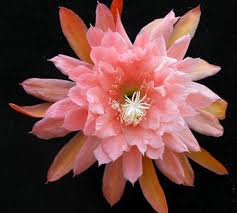
                                              German Empress hybrid
This is epiphyllum blooming season in So Cal. Always forget how spectacular they are. This year the pink and  coral shades are blooming  now on the place, and reds are in the nurseries.

Epi’s bloom through the spring and into summer. My experience is that the bloom times are fairly unpredictable, but my plants are from plants that were 50 years old  when the cuttings, unnamed, were made. Modern hybrids are possibly more reliable?

America's Sweetheart hybrid

In  innocence (polite term  for ignorance) thought I could easily give a description of the various types of epi’s. Wrong. To generalize madly---modern epi’s are the result of hybridization with day blooming  types, hyliocerius and night blooming cereus.( The best account of the epiphyllum species is probably the website Got Epi’s ( http://gotepis.com/drupal/node/4.--- )   Highly recommended.

Meanwhile the word epiphyllum comes from Greek and means “upon the leaf” which is where the blooms occur.
                                                               e. akermanii
Though hard to classify neatly, most epiphyllum are easy to grow in So Cal--they like dappled shade, bloom best growing  in pots (mimicking the tree forks they like in their natural state), a bit of water, but not too much--every 10 days in the summer is good--- a potting soil for terrestial orchids works . Or use a formula especially for epis consisting of potting soil, bark, a bit of perlite. In other words-rich but fast draining. Every grower has his own perfect recipe.
                                                           Epi Rose Samoa
Generally grown from cuttings--- hopefully find a friend for free ones--- or a vendor on the Internet. Actually the free ones might come into bloom faster, if you can score an old leaf. Epi's bloom on older leaves. Vendors generally supply newer leaves, which are going to take maybe 3 years to come into flower.
 Epis are first cousins to Dragon Fruit ( a hyliocereus) (see earlier blog August 22 , 2011) . DF's take 2-3 years to begin flowering and fruiting. All hybrid epi's have hyliocerues in their parentage, otherwise they'd bloom only at night. The colored day blooming epi's have night blooming cereus in their parentage if they are fragrant. ( Surmise! This is tricky stuff. ) Here is the Night Blooming Cereus in one of the most goth illustrations around:
   From  Dr. Robert John Thorton’s The Temple of Flora.                                  1799.**

                                                                         
Though hard to see in this print, in the background there's  a clock tower pointing to midnight, emphasizing that the cereus flower lasts only for one night. It is very  scented.
Caveat emptor-- many of the plants called night blooming cereus aren't. They are epiphyllum oxypetallum which is a glorious and dazzling plant in it's own right.

                         Queen of the Night (Epiphyllum Oxypetalum)
The leaves of the Queen are flat, epi leaves.Night blooming cereus has funny, spiny,gangling  round leaves.( see 1799 illustration above)
                      Here is Night Blooming Cereus climbing a palm tree

 Some Night blooming cereus are temperamental along the So Cal coast. (Epi's aren't) Had one cereus that grew and lived for many years but never bloomed.Triangular leaf. Acanthocereus tetragonus. Too dry for it at 1200 feet up in the foothills.Acanthocereus tetragonust is a native of S. Florida, needs a more humid, tropical climate than our semi-arid foothills.Might grow along the coast in a sheltered hot spot?
                      
                               This one is also called Barbed Wire plant
Another cereus that blooms profusely along the coast in So Cal is c. peruvianus, which also bears fruit (pitahaya) . It blooms at night (of course) is scented and grows fast. Mine used to bloom in July. Gave it away and planted an apple tree instead.( Like apples better than pitahaya.)

                  c.peruvianus                         

Bet you're  glad we got that  sorted out.....
The weather this spring has swung so madly from hot to cold, accompanied by late rains it’s  no wonder the epis are in major  survival mode.” If the plant is very healthy it doesn't feel threatened and won't bloom"* We like to think plants bloom and fruit trees bare when they are happy. This is—to an extent, true. But they also react to stress by  blooming more and setting more fruit to ensure their survival, much as the human birth rate rises in times of war.


                                                                  St. Louis Spring hybrid
Stormy Weather
This one is a favorite-tempramental bloomer- but worth the wait for its fushia interior and scarlet exterior. The plant is about 20 years old. Blooms best if left in at least 1/2 day sun along the coast. Move into shade once blooms are set.

See even more epi's having a survival party at :
                                            EPICON XIII
                    The 13th International Epiphyllum Convention May 26 & 27, 2012
             http://www.sandiegoepi.com/epi/epicon_xiii
Notes

* quote from Got Epi's

** This has recently been re- published in several editions


Wednesday, April 4, 2012

Clivias--blooming now-great colors


                                           Clivia hybrid Gloria 
The last time I looked at clivias for sale was back in the Jurassic apparently, since I had no idea clivias come in peach, yellow, white, orange and green.


Clivia originates in S. Africa, and is pefectly adapted to So Cal—and surprisingly tough if grown in light shade. Gets by just fine on whatever rainfall we have. Available locally for gardens are the usual suspects in orange and salmon.

                                               c.orange
 
                                  Teaparty hybrids from                                           (northamericancliviasociety.org bred by Tom Wells)
However, if this is not enough gloryyou can buy very fancy (ie fairly  expensive--- about $8.00 U.S dollars for a packet of3 )--- seed for clivias in an amazing range of color and form and grow them in pots, take them to shows and win prizes . ( It does, however take about 3-4 years for them to flower from seed.)
 
Local nurseries have both orange and yellow plants in stock at about the same price as agapanthas. ( A bargain.)
 
 For seed try  (http://www.hiltonclivias.co.za/sales/pictures/listings/44_29.jpgsee). Or http://www.capeseedandbulb.com/ or http://cliviamart.com/, or http://cliviausa.com/. The last site is the most informative.

What’s more, there’s a Clivia Society http://www.cliviasociety.org/    Who knew?
 Much tempted to take a flyer on some seed and fling myself into the whole clivia adventure.
Growing clivias:
 Clivia  leaves will burn in the sun, so in the interior valleys in So Cal, under  50% shade cloth is the easiest way to grow them.

                                                    Salmon
For those devoted readers in northern climes who want to grow clivias as houseplants see Google where copious notes abound on growing them as indoor plants. Basically the same culture as a hippeastrum.
                                  
My experience is to grow them as you would an agapantha, but be sure the clivias are in shade. Regular garden soil. Mine have grown happily for a lot of years with almost no care. They bloom in the spring—right now along the So Cal coast. Being so cavalier with them is possible because they are S. African, Cape of Good Hope native----and their  original climate is so much like ours. 
                                               
You know my methods, Watson……Clivias were first  collected c. 1814 by William John Burchell
                                  
     
Accompanied by 10 Hottentots and 2  wagons Burchell explored and collected 50,00 plants to the Royal Botanical Garden at Kew, funding the expedition himself. ( He was the son of a wealthy nurseryman so he had both money and practical experience.) You can read his Travels as a Google digitalized book----free ** 
Burchell’s book about his expedition was  apparently , or possibly (?) inspired by Humboldt. Burchelle followed Humbodt’s footsteps to S. America (Brazil) kept copious notes which he left to Kew. His Travels in the Interior of Southern Africa, was published and re-printed in 1967.
Burchell's watercolor of crossing the Berg River

He also found  this very decorative zebra:

                                                                              
  Burchell encouraged the British settlement of S. Africa which eventuated in the Boer War; Britain wresting South Africa from both the native S. Africans and the Boer settlers. They had proceeded the British in appreciating the wonders of the Cape climate, flora and fauna.
Despite his achievements Burchell  he never attained super hero status. .Burchell’s efforts were not fully recognised by his contemporaries. ( Darwin’s Voyage of the Beagle was a hard act to follow.)

 Burchell,was unlucky in love (his fiancé jilted him). His outstanding work as a botanist went largely under-appreciated. He became reclusive  in his later years and ended up committing suicide

. His delicate sensibility is evident in this water color from his South American travels.


                          The Beach at Rio de Janiero

Clivias are his present to the present. Burchell  may not have been a super hero but he was asplendid botanist, artist  and plant explorer, and an interested observer of Cape life under the Dutch.
Here's his water color of a kraal.    

     Notes: http://www.americancliviasociety.org/Article-5.html. *from an article in the American Clivia Society website.


** For Travels in the Interior of S. Africa- go to: http://play.google.com/books/reader?id=4r8NAAAAQAAJ&printsec=frontcover&output=reader&hl=en

Recommended, free and entertaining. Thank you Google!