Search This Blog

Powered By Blogger

Wednesday, April 4, 2012

Clivias--blooming now-great colors


                                           Clivia hybrid Gloria 
The last time I looked at clivias for sale was back in the Jurassic apparently, since I had no idea clivias come in peach, yellow, white, orange and green.


Clivia originates in S. Africa, and is pefectly adapted to So Cal—and surprisingly tough if grown in light shade. Gets by just fine on whatever rainfall we have. Available locally for gardens are the usual suspects in orange and salmon.

                                               c.orange
 
                                  Teaparty hybrids from                                           (northamericancliviasociety.org bred by Tom Wells)
However, if this is not enough gloryyou can buy very fancy (ie fairly  expensive--- about $8.00 U.S dollars for a packet of3 )--- seed for clivias in an amazing range of color and form and grow them in pots, take them to shows and win prizes . ( It does, however take about 3-4 years for them to flower from seed.)
 
Local nurseries have both orange and yellow plants in stock at about the same price as agapanthas. ( A bargain.)
 
 For seed try  (http://www.hiltonclivias.co.za/sales/pictures/listings/44_29.jpgsee). Or http://www.capeseedandbulb.com/ or http://cliviamart.com/, or http://cliviausa.com/. The last site is the most informative.

What’s more, there’s a Clivia Society http://www.cliviasociety.org/    Who knew?
 Much tempted to take a flyer on some seed and fling myself into the whole clivia adventure.
Growing clivias:
 Clivia  leaves will burn in the sun, so in the interior valleys in So Cal, under  50% shade cloth is the easiest way to grow them.

                                                    Salmon
For those devoted readers in northern climes who want to grow clivias as houseplants see Google where copious notes abound on growing them as indoor plants. Basically the same culture as a hippeastrum.
                                  
My experience is to grow them as you would an agapantha, but be sure the clivias are in shade. Regular garden soil. Mine have grown happily for a lot of years with almost no care. They bloom in the spring—right now along the So Cal coast. Being so cavalier with them is possible because they are S. African, Cape of Good Hope native----and their  original climate is so much like ours. 
                                               
You know my methods, Watson……Clivias were first  collected c. 1814 by William John Burchell
                                  
     
Accompanied by 10 Hottentots and 2  wagons Burchell explored and collected 50,00 plants to the Royal Botanical Garden at Kew, funding the expedition himself. ( He was the son of a wealthy nurseryman so he had both money and practical experience.) You can read his Travels as a Google digitalized book----free ** 
Burchell’s book about his expedition was  apparently , or possibly (?) inspired by Humboldt. Burchelle followed Humbodt’s footsteps to S. America (Brazil) kept copious notes which he left to Kew. His Travels in the Interior of Southern Africa, was published and re-printed in 1967.
Burchell's watercolor of crossing the Berg River

He also found  this very decorative zebra:

                                                                              
  Burchell encouraged the British settlement of S. Africa which eventuated in the Boer War; Britain wresting South Africa from both the native S. Africans and the Boer settlers. They had proceeded the British in appreciating the wonders of the Cape climate, flora and fauna.
Despite his achievements Burchell  he never attained super hero status. .Burchell’s efforts were not fully recognised by his contemporaries. ( Darwin’s Voyage of the Beagle was a hard act to follow.)

 Burchell,was unlucky in love (his fiancé jilted him). His outstanding work as a botanist went largely under-appreciated. He became reclusive  in his later years and ended up committing suicide

. His delicate sensibility is evident in this water color from his South American travels.


                          The Beach at Rio de Janiero

Clivias are his present to the present. Burchell  may not have been a super hero but he was asplendid botanist, artist  and plant explorer, and an interested observer of Cape life under the Dutch.
Here's his water color of a kraal.    

     Notes: http://www.americancliviasociety.org/Article-5.html. *from an article in the American Clivia Society website.


** For Travels in the Interior of S. Africa- go to: http://play.google.com/books/reader?id=4r8NAAAAQAAJ&printsec=frontcover&output=reader&hl=en

Recommended, free and entertaining. Thank you Google!


Wednesday, March 21, 2012

The cloud forest concept and Alexander Humbolt


                                             the Humboldt Current


Pelicans feeding -Humboldt Current
 The Humboldt Current ---isn't that somewhere off South America? What is it anyway?

 It's the cold current that creates some of the world's richest fishing grounds,* and makes for excellent  wines from South America. It creates cloud forests.

                                            Cloud Forest

 It is one of the few reminders in the New World of it's least appreciated , super hero naturalists, Alexander Humboldt.

The idea that a climate  could being more than one place—that a cloud forest can exist in on the Olympic Peninsula, in Guatemala, in Brazil, on the Azores—that breadth of conception we owe to  Humboldt, naturalist, geographer and explorer in the New World.

 Humboldt is an Promethean character on all counts. He’s a figure of the Late Enlightenment, or an early Romantic, depending on what you see in his work. (He and Napoleon were born in the same year, and despite the fact most of us have never heard of him, in his own time ,Humboldt was as well known as was Napoleon.)
  Here’s his self-portrait (did I mention he was an accomplished artist and draftsman as well?)

 Humboldt was absurdly well educated, a Romantic, a radical, a Prussian aristocrat (?) who  lived most of his life in France, wrote in French, and  was a freethinker like Jefferson. Yet --- Humboldt  persuaded the king of Spain to let him travel, and explore  Spanish S. America---the first "heretic" allowed in since the Conquest  (c. 1634)

                    Humboldt  mapped and explored the Orinoco River ( 1799-1804 )                      

one of the world's great river system-- enormous, swarming with extraordinary animals . He entered  and described a region totally unknown to most Europeans. The Orinoco area is steaming—4 ° from the Equator                   


Humboldt and his botanist companion, Aime Bonpland, travelled by dugout canoe accompanied by mountains of equipment --a miracle in itself--- and encountered an Alice in Wonderland collection of   animals.

Dugout canoes, present day, Orinoco River

                         The cabybara, a kind of giant guinea pig


                   much favored as a snack by the native jaguars and crocodiles


(Jaguars, in turn, were hunted for their coats by the Carib Indians of the region)


                                      Orinoco crocodile (50 feet not unusual)

Humboldt wrote about the creatures, plants, Indians, mission fathers in his Personal Narrative --(out in paperback with a wonderful cover.)


Humboldt, looking the Byronic hero, accompanied by Aimé Bonpland, busily taking notes (Bonpland did a lot of the grunt work) and various indigenous people who managed to transport everyone and all the equipment in the dugout canoes--the most "tender" of crafts--without losing any person to the caimans or crocodiles. (En passant , Humboldt also  described the piranha.)

The tone of the Personal Narrative is cool---intrepid, good-humored in the modern translation.  (Humboldt wrote in French. An 1889 digital copy is on the Internet, more romantic in tone. ) . Humboldt  sympathized with the Wahara and the other tribal people he met, finding them “sad “ rather than savage, depressed by their subjugation to the Spanish, and made “stupid” by being forced into drudgery and farming by the mission fathers.


Humboldt who  was deeply anti-slavery, thoroughly disapproved of the mission system of forced labor.

Besides the Personal Narrative, Humboldt's Essay on the Geography of Plants sets out his revolutionary descriptions linking plants with geographic features, rather than places. In the process he created a new scientific method based on careful data, elevation, weather systems, ocean currents (as the cloud forest in the Azores Chile, Japan etc.) and other empirical data. (see The Humboldt Method in  W)
This book, though frequently published has never been available in its present form, printed and edited by the U. of Chicago Press, as an e book.**

We'll let Stephen T. Jackson who edited this edition have the last word:   "the legacy of Alexander von Humboldt (1769–1859) looms large over the natural sciences. His 1799–1804 research expedition to Central and South America with botanist Aimé Bonpland set the course for the great scientific surveys of the nineteenth century, especially Darwin’s travels to South America, and inspired such essayists and artists as Emerson, Goethe, Thoreau, Poe, and Church” 
Super Hero!  But what I loved the most was Humboldt's ability to empathize with his subjects-- the "unfortunate capybara" pursued by jaguars, flinging itself into the river, only to be eaten by a crocodile. 
Science with a heart.


** " Among the most cited writings in natural history, after the works of Darwin and Wallace, this work appears here for the first time in a complete English-language translation".

*W says "The Humboldt Current LME is considered a Class I, highly productive note: (>300 gC/m2-yr), ecosystem. It is the most productive marine ecosystem in the world, as well as the largest upwelling system. The Humboldt’s high rates of primary and secondary productivity support the world’s largest fisheries. Approximately 18-20% of the world’s fish catch comes from the Humboldt Current LME. The species are mostly pelagic: sardines, anchovies and jack mackerel. The LME’s high productivity supports other important fishery resources as well as marine mammals. The cold, nutrient-rich water brought to the surface by upwelling drives the system’s extraordinary productivity.

Wednesday, February 29, 2012

The Mexican Lime (Citrus aurantifolia) Talks Back


Truly  demented readers will doubtless remember the Mexican Lime that has been Mano a mano with me since 2009. For less passionate readers  (see Dec 13 2009 blog)--- bought this lime tree, put it against a hot wall where it lost  its leaves when the temperature dropped into the 30’s. Thinking it was dying, applied first aid a la UC Davis by wrapping it in Christmas lights.
Then moved it to south side of the house on snazzy new terrace. Lime responded by bearing 3 very seedy  limes ( 6/9/2010). It then promptly once more lost its leaves in the next cold spell.Argh.
No image--I was planning to give it away!
Had the gardener move it to a 20 gal black pot, return it to the west side, but this time sheltered by a bamboo hedge (the roots) while its head was in the west sun. The plan was to give it to some non-gardener who would give it a new home, not knowing how surly and unfruitful a tree it was. (Wanna buy a duck? …)

The Lime got watered occasionally along with 2 other potted tangerine trees with whom I had no quarrel. Au contraire, they were good trees and bore profusely.Forgot about putting the lime on Craig’s list temporarily and finding a new home for the balky thing.


Apparently the deva in charge of this tree has a wicked sense of humor--why am I not surprised?


The lime tree today  covered with blossoms . Bees are clustered on it. ….. okay, okay….flowers are being pollinated. Can’t give it away--- now. Score: Lime 3, this gardener 0.
Chastened--- resolve to be more respectful of plant communications in the future.
Scrub Jay W
 Standing in the kitchen door, brooding over defeat at hands of lime tree when Cheeky Bird whisks into the kitchen past my ear, lands on the counter and squawks at me. Cheeky Bird is a scrub jay who has trained the entire household to give him peanuts---or else.
(This is a w common photo, but since to the uninitiated eye, coastal Western scrub jays all look alike…. Cheeky does not trust cameras.) What is so remarkable about Cheeky Bird is that he has taught 2 generations of offspring to :
1) recognize the peanut givers from the non-peanut givers in the household (2 to 2)
2) Get the peanuts by sitting on the handle of a basket ---but not come in the kitchen. Instead the offspring make a small chuckling noise as if to say, “I’m here, waiting…” whereas Cheeky  himself is noisy demanding and unabashed about coming into the house.
                                                                        W

 Cheeky is a corvid. The group includes ravens, crows and jays. Crows and ravens have been studied pretty extensively-- see http://www.pbs.org/wnet/nature/episodes/ravens/introduction/1506/ on Ravens.
 The U of Oregon did a whole documentary on crows (called, believe it or not, Crows) which played at the Santa Barbara Film Festival. The scientists at U OR were rather astonished to find crows recognize individual human faces, have "culture" , teach their young to recognize the good guys from the bad guys.

 So far as I know, jay birds are bereft of a scientific study on their intelligence, but size doesn't count. Jays recognize individual faces, and teach their offspring to recognize people just as crows do. It's also been established jays and crows have episodic memory---they don't forget where they put their car keys....

Next: a new super hero---- Alexander von Humboldt


Saturday, February 4, 2012

David Austin "English Roses" for So Cal and a Meilland

Darcy Bussell

This rose is named for  the premier ballerina of the Royal Ballet. She was 20. Darcy went from strength to strength as a dancer and was awarded the OBE. Here she is in Balanchine's Rubies.

The rose named in her honor  --unlike some of the Austin roses---  is especially recommended for our zone and will " will remain bushy and compact even in the warmest areas, making it ideal for the front of rose beds or the mixed border" . And it smells good. If you can't find this rose in stock now at your local nursery, hasten to the Austin website and order one there.http://www.davidaustinroses.com/american/Advanced.asp?PageId=1893.

David Austin is too well known to need any detailed biography here--and it's all on the Austin website anyway. However, he's my hero because all his roses smell like roses used to smell, and some smell absolutely heavenly. Austin roses have a character of their own. The first ones this gardener tried all grew nicely but were slow to establish themselves-- Gertrude Jekyll, Graham Thomas,Pilgrim,. However, Teasing Georgia and  Abraham Darby took off running

. In recent years Austin has his  roses sold in this country,  grown in Tyler,Texas, and many of them are totally  adapted to our climate.


Jude the Obscure

This rose , besides being spectacular has won some impressive prizes for scent  which is described as " having a strong fruity fragrance with hints of guava and sweet white wine". Hmmmm.....this sensual delight is not one of Austin's more appropriately named roses . It applies to one of Thomas Hardy's more depressed character( which is saying a lot, as most of them are depressed.)  Jude hangs himself. Perhaps Mr. Austin is not a great reader? Any votes out there for re-naming it Jude Law, a sensual delight to the eye even if we don't know how he smells?


                                             Molineux

This lovely won the medal for Best Scented Rose of the Year** . What makes it a sure thing  is the fact that it is named for the Wolverhampton Soccer Team.With recommendations like that ........ how can we lose? 

Not to be missed is another recent rose


Lady Emma Hamilton

And what did she do? Quite a few scandalous things***. She was a country girl who made it in London, (she was Romney's favorite model) married a Lord and became the lover of British  naval hero Lord Nelson. Austin named the rose to commemorate the Battle of Trafalgar. Well, okay, perhaps a bit of a stretch..... but Lady Emma is luscious has a strong "fruity scent of pear grape and citrus. It is vigorous and free flowering. 

Last but far from least, is Meilland's Yves Piaget,  named for the president of watchmaker/jeweler SA Piaget. ( Piaget is a famous  French firm of long standing ---made watches for Napoleon). Yves It is a superb rose, tough, undemanding and disease resistant .


Yves Piaget

This rose smells spicy, and has great substance which makes it a great cut flower. It lives without complaint, on grey water from the washing machine and is a particular favorite in this garden.

Notes

** at the Royal National Rose Society Trials
*** See movie starring Vivien Leigh and Lawrence Olivier That Hamilton Woman made when Leigh and Olivier were young and in love. In black and white, not a memorable  film but do they  look good. 


Monday, January 16, 2012

New Roses for 2012-- a selection

Sunshine Daydreams

Breathes there a man with soul so dead”….that his heart doesn’t leap up at the thought of new roses for the year? This  gardener  already has about 50 roses that live on grey water, unsprayed for the most part, and when sprayed it's either with milk, for black spot, or pepper spray for bugs.( Having established the politically correct  organic credentials for rose growing), let's see a few.

Sunshine Daydreams is a grandiflora described as “yellow to cream”. Not for a pot on the patio but give it some room and it will be a rival to Abbé de Cluny. And, best of all Sunshine Dreams managed to win AARS under no spray conditions. According to the breeder it is almost continuously in bloom. Give it room—5 “by 4’ when mature.


                                               Koko Loko

This one caught my eye lavender and cocoa? Koko Loko. As you can see, it begins one color and ends up the lavenderr you see  at the bottom left. It’s a floribunda, moderately fragrant . “Milk chocolate changing to lavenderr” according to Weeks, the grower, and a good cut flower.Sounds a little like Lavenderr Lassie, an old climber, much loved. Tempted to try it.                                       

                           
Pink Traviata

The next rose is a sport  of Traviata  (a rose  this gardener has successfully grown for about five years). Very tough, floriferous and undemanding. Grown by the unrivalled rose-breeding family, the Meillands, in Provence.
This rose is one of their series of Romantica© roses that are ideally suited to the Central Coast. Almost any plant from Provence seems to thrive here whether it is artichokes (remember the baby purples grown from seed) or roses. This particular rose, Pink Traviata, is a hybrid tea, fragrant,  evoking Violetta,  in Verdi’s opera**  La Traviata“The Woman who Goes Astray”.
 Scratch a rose grower and find a Romantic….. For four generations the Meilland family has been raising memorable, much loved and admired roses. Perhaps the most famous is Peace (which flourishes here), and commemorates the end of WWII . This rose was  originally named for Mme. A. Meilland.(  see   www.meilland.com/en )
                                                       Luscious
This rose is Luscious--magenta and amber, bewitching fragrance, long stems.Hybrid tea. Always a fool for scent, this one sounded like a winner, however, not 100% sure it will do well along the coast, as it was bred in Tyler,Texas. It'll be well suited to the Central Valley, and should like the heat.

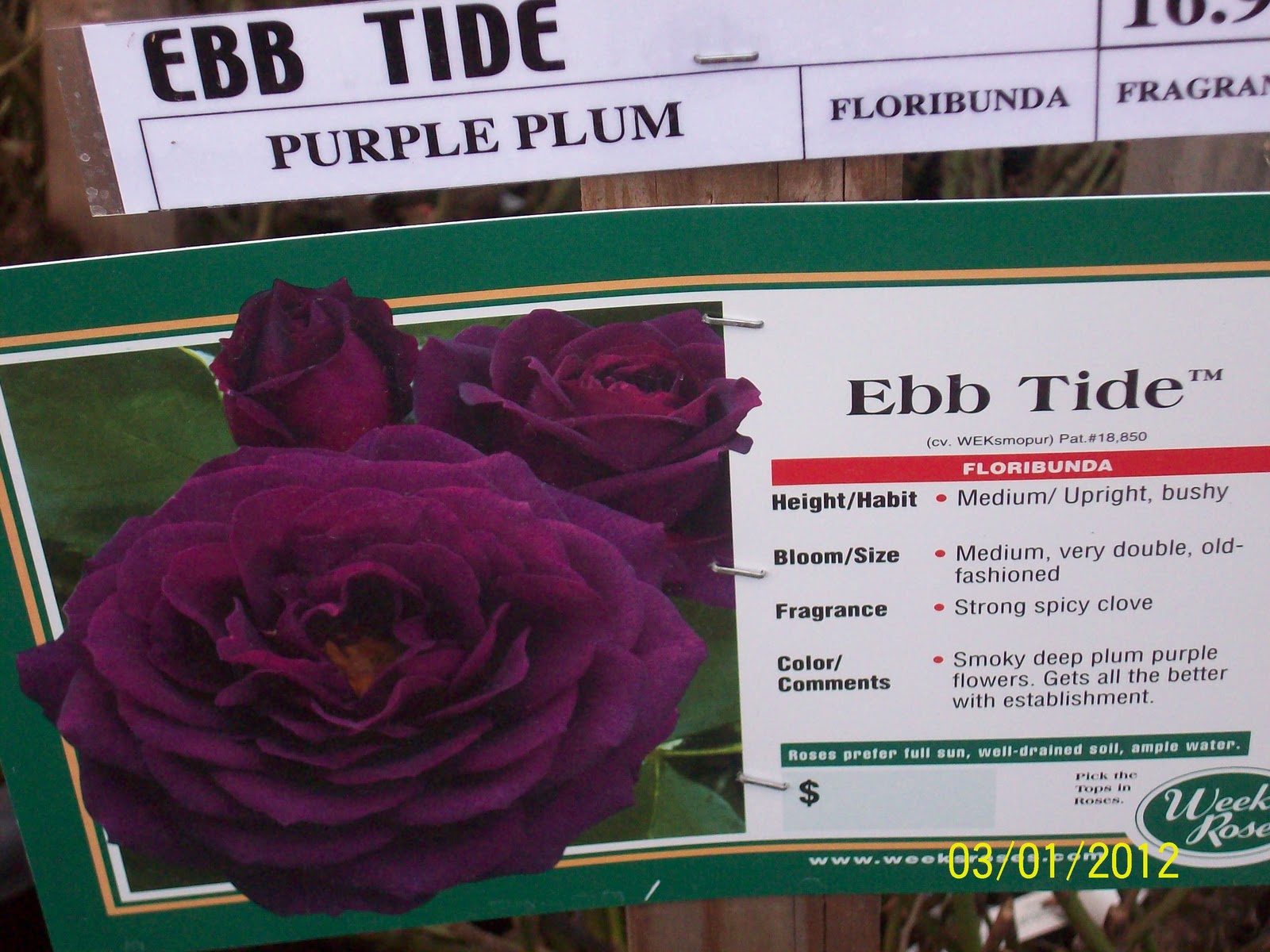
                                                                   Ebb Tide

This rose is newish (2006) but not new this year, however the color is so remarkable and the scent---"strong spicy clove scent" -- so endearing, Ebb Tide made the cut.It is a floribunda. (Next blog will discuss David Austin roses for this year, which will include DA's featured rose for the year Darcy Bussell, which is in the same color range)
 If you are after this color, compare the two roses and figure out which will work best for you. Ebb Tide was bred in Australia, which indicates it'll probably flourish here. Carruthers (the breeder)  patented the rose in 2006, and Weeks, a California grower, has been carrying the rose for several years so it must be better than okay. 
Now, to try not to  get carried away  at the nursery.......
                       
** from Dumas fils play.

Monday, December 19, 2011

Hippeastrum (a.k.a.as "amaryllis"-they aren't)

Equestre

The trouble begins with this beauty. Linneaus named it Amaryllis Equestre ("Knight's or Horseman's Star") It came from Surinam--2 to 5 degrees from the Equator  on the coast of S. America, next to Brazil . Surinam is very tropical , has 2 wet seasons and  2 dry*.

This tropical "amaryllis" caused the next round of botanists no end of trouble, as it turned out Equestre was not inter-fertile with the S.African bulb, already named amaryllis. Equestre was a different genus with different blooming habits.


Surinam c 1840
 
Hands were wrung, decisions were made as tactfully as possible by one of our heroes
Dean of Manchester, the Hon. and Rev. William Herbert the final authority on amaryllis.(see earlier blog). He decided to create a separate genus name for the S. American bulbs, which besides being tropical,  had a differently shaped bloom than the A. belladonna lily from S. Africa, and quite different growing habits.

Amaryllis Belladonna

                                                     AppleBlossom, hybrid (Hippeastrum)

Why do we need to care?

 Because one kind of amaryllis--- the S. African --often sold in California as "garden amaryllis" can be grown all up and down our coast with no more trouble than a Naked Lady. The most common color seems to be red, which is fine--since already have our Naked Ladies in profusion.


Naked Ladies (come from Mexico)


The tropical Hippeastrum behave rather differently. They can be grown outside in sub tropical  areas-- the South Coast.They'll manage on the Central Coast at least as far north as Santa Maria outside. They tend to revert to blooming when the Horseman (Centaurus) is rising


in the spring.

However, they've been hybridized to bloom in December, if watered. (Since the 2 wet seasons they started out being used to, are the hybridizer's delight.) These are the ones that can be depended on to bloom in their individual pots at Christmas time.  Happy Hippeastrum!

                           H. (Species) Papillo   -"  Butterfly"  from Brazil


Once had an  ambition  to have enough amaryllis and hippeastrum growing to use them as cut flowers.....then realized this was probably a form of horticultural hubris that would result in every snail in So Cal descending on the garden and eating the leaves of both Amaryllis and Hippeastrum as they emerged from the ground.

                   ****************** *************************


Macedonian coin showing the horseman's star Centaurus
                                             c. 320 B.C.

*See p 138 of Herbert (1837) Amaryllidaceae . Linneus named his bulb Equestre. Lat. gen.-- refers to The Horseman constellation.That's why politic Herbert kept the idea going in Hippeastrum. (Horseman's Star).

 When the Horseman rises the spring rains are coming, and this observation goes back to the Sumerians. That's when the Hippeastrum bloom along the Coast here, if planted in the garden..