Search This Blog

Powered By Blogger

Tuesday, November 29, 2011

Lycoris- more denizens of the cloud forest

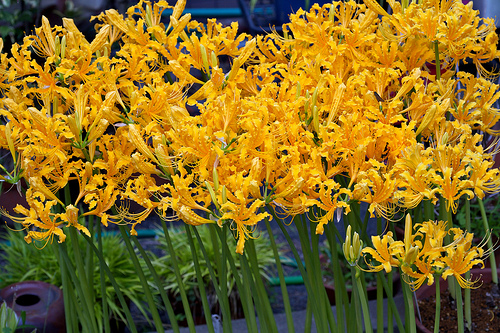
Lycoris aurea

Lycoris originate in Asia-Japan, Korea, China and mountainous area in other Asian countries. Most of the lycoris we received in the West had long been hybridized before we received them in the 19th c.. Lycoris radiata is a native species in Japan  (or maybe it's China--experts disagree). Anyhow we got ours in the U.S when Perry opened up Japan in the mid-19th c.


.
Since Japan and our Central Coast are close in latitude (between 45 and 34 N ) lycoris are a natural for us to grow here. The lycoris are also called Spider lilies--not very poetic, but reasonably descriptive.

Lycoris radiata in a grove-Japan

To the Japanese, lycoris are the stuff of legend-- of passionate but doomed lovers. The fall flowering of the flower after the leaves have disappeared gave the lilies the an association with death, the dying of the summer, an elegiac ambiance. 

William Herbert
Synchronicity appears to be at work in the naming of Lycoris. Another of those absolutely amazing and accomplished botanists appears. He did a magnum opus on the whole  family of Amaryllidaceae,* The Rev. and Hon. William Herbert  was a lawyer,M.P.,poet,classics scholar and formidable botanist.**

Lycoris alba.
Lycoris was the name of a cycle of elegiac poems written by Gaius Cornelius Gallus to his mistress (less fortunately named Volumnia). Herbert had just been whipping out translations of Greek and Roman poetry.

He had to  know Gallus was considered the first elegiac love poet  in Roman literature. ( The Gallus/ Lycoris story had a suitably doomed lovers ending as Gallus committed suicide.) Herbert named this fall blooming bulb to echo it's mythology in the Orient. Elegant!

Herbert's home in West Riding.
Have a look at Lycoris alba.This beauty was planted around houses to keep rodents out. The bulbs of all lycoris are very poisonous and ideal for decorative  pest control . (The Amaryllidaceae family, which includes narcissus, tends to be lethal if eaten.) Lysine is the poison derived from Lycoris. It's a protein inhibitor which is presently being investigated in the treatment of some cancers.

Border of lycoris
But the best reason for growing lycoris along our So Cal and Central Coast is it's beauty and ease of culture (for us).

 Like all the bulbs in this family it deeply resents being disturbed at the wrong time, and may sulk for a couple of years if displeased. The bulbs can be planted now and several nurseries have them (http://chenyinursery.com/i/t-214.jpg; http://www.willowcreekgardens.com/c-58-lycoris.aspx.  Lycoris, in our climate can be planted until Dec. 31. 

So---what are you waiting for?


* available as a download free from Google. 
** Herbert was a direct descendant of Mary Herbert Sydney, Countess of Pembroke,
the literary ornament and patron of the Elizabethan period.

Mary Herbert Sydney
                                                     by Nicholas Hilliard

Monday, November 21, 2011

Denizens of the Cloud Forest for So Cal -Nerines


Nerine bowdeni
If you have only seen a nerine in a vase, or a couple of bulbs in a border, the notion you could grow them in drifts  (budget permitting) is an epiphany. Futhermore it turns out that nerines have a very glamorous history. The first ones that got to Europe from their native S. Africa came on an East Indiaman that was wrecked on the shore of the Island of Guernsey in the English Channel. It was called the Guernsey lily, or the Jewel Lily.
 N. sarniensis 
"Originally found on Table Mountain overlooking Cape Town in South Africa, the jewel lilies flower in a spectrum of colours from their original oranges, scarlet and white through new purples, pinks, mauves, reds, scarlets, copper and bronzes where they scintillate in the sunshine with gold or silver crystalline flecks that make their petals sparkle." (Exbury Gardens.com)

Nerine bowdeni also came from S Africa ,the Drakensberg mountains, and was sent in seed form by Athelstan Cornish-Bowden to his mother  c 1904. This good lady raised the nerines then sent the seed off the Kew, asking the plant be named for her son.**


Exbury hybrids

Somehow, the nerine sarneiensis came to the attention of one of England's most accomplished and passionate botanists--- Lionel de Rothchild. Rothchild was of family necessity aa  banker,  and a successful  politician, but he described himself as a gardener by vocation.

Lionel de Rothchild

Rothchild was another of those extradinary men who turn up in love with botany. He bought the Mitford estate --yes, those Mitfords ("Love in a cold Climate") and proceded to build a beautiful Georgian house with acres of greenhouses in which he hybridized nerines in the 1920's and 30's. (Obviously he was very, very rich. well as being remarkable.)

Exbury House

Rothchild sold the unsurpassed nerine collection to another maddened nerine lover. The nerines went to Switzerland with Sir Peter Smithers where they thrived and became more various and beautiful until Sir Peter felt he could no longer care for them properly . He sold the collection back to the Rothchild's in 1995. Nicholas Rothchild who is Lionel's grandson and president of the Nerine Society, has taken charge of the collection. Quelle histoire. These are lucky, lucky  bulbs!

Naked Lady (she's a Mexican native)

What is even nicer is that with their Table Mountain, South African DNA we can grow them along our Central Coast with no trouble at all. Just like our ubiquitous Naked Ladies they flower in late summer, and early fall ---however, keep their strap like foliage.

                                           
** This hot off the press from The Telegraph (British paper) 11/26/11


Next: "Amaryllis" Hippeatrum and Lycoris. More bulbs to plant now from cloud forests.

Monday, October 31, 2011

Blue bamboo, Damarapa and the cloud forest at SFBG

Damarapa bamboo
Blue bamboo
This is a real/surreal color. The new growth is blue, it then turns green, then pale  gold. It's proper botanical name is Himalayacalamus hookerianus, its a native to China. It is non-invasive, clumping and grows to a height of 20 feet. It flourishes in the SFBG as do many denizens of the Cloud Forest.Where has blue bamboo  been all my life?

The Cloud Forest is going to be something So Cal coastal residents may become more and more interested in, as our annual summer temperatures continue to drop. We get more like a cloud forest everyday. So what is it? A cloud forest is also called a fog forest, and exists both in the tropics and in more temperate zones. "It is characterized by  a persistent, frequent or seasonal low cloud cover..." W .

 May Gray, June Gloom, July Why, August Less ...our 10 degrees colder summer is certainly characterized by a persistent, frequent or seasonal low cloud cover..."  That's the bad news. The good news is Cloud Forests are home for some of the most exciting plants on the planet. The San Francisco Botanic Garden in Golden Gate Park (larger than Central Park in NYC) devotes big swatches to the Himalayan Cloud Forest plants, and even more territory to the Meso American Cloud Forest which covers over 7,000 miles of the Americas, as well as the Canary Islands, parts of South Africa and
Australia, New Zealand and our own Redwood Coast. So even if our favorite Big Boys are not ripening properly, there can still be joy in Mudville...We could do this.
 

                       Nerines in drifts at SFBG- Nerine bowdenii from S Africa
 
We could grow a giant salvia the hummingbirds were clustered around


Hummingbird Heaven
 
This salvia can easily grow to 6 feet if you let it. If you have a shady spot under a big pine, a place few plants really like you could grow a patch of crinum lilies:

                                                Crinum moorea
This have enormous, hard to dislodge bulbs, so be sure about where you are planting them. Tried digging some up once. You'd need a jack hammer. Like the nerines and our Central Coast "Naked Ladies" the crinums are members of the amaryllis family. Some are S. African natives as is this one. "Port St Johns (Eastern Cape) form: pink flowers produced in September to October"  From the Natal Botanical Garden http://www.plantzafrica.com/plantcd/crinummoor.htm.

Crinum moorea growing at SFBG
Keep crinums (which you could grow from seed from the Natal Botanic Garden) in the shade. NBG says any sun spoils the leaves and flowers.

There are more, stay tuned, for the native plants of the Meso American forest.

Wednesday, October 19, 2011

Aeoniums and Echeveria setosa -- tough guys

Aeoniums- and the name tells you a lot, as it means immortal  -- flourish madly on the Central Coast Their point of origin is the Canary Islands off the NW coast of Africa at around 15 degrees of longitude.


Aeonium arboreum is a resourceful plant when it comes to drought. Not frost proof (though probably would come back from the root, if the frost were brief) . The plant strategy is to grow big and flat, with lots of thin shiny leaves.It easily attains a size of 3 feet across, growing pups under its rosettes at a brisk rate for a succulent. It's motto is "size matters".
'Schwarzkopf'
It's smaller but also prolific, shiny and dramatic, very chic these days as "black" flowers are the "in" thing is Aeonium arboreum var atropurpureum 'Schwarzkopf', or Black also known as Tree aeonium . This one looks great with chartreuse colored succulents. It's all over the place in the Getty Gardens in giant pots, looking very fashionable.
The next plant strategy is a little different. Here is A. tablaforme (like a table.)

   
                                        from Scientific web. com 
Not only is it big, many leaved and flat, but furry. The small hairs all over the leaves are great moisture catchers. (So much so that A. tablaforme rots in captivity rather easily. Water it no more than you would a resting orchid if its inside. Outside in SoCal, along the coast, don't water it. It's perfectly adapted to a maritime climate.) It's reproduction strategy is a little different . It colonizes:


The next one is in here because it's s-oooo pretty. But also furry, colonizing and doing what all these aeoniums do when its going to rain--forming cups of their leaves.
                                          A. glandulosum  from Madeira

If you have an appetite for more aeoniums go to the site of a passionate collector, now unfortunately  décèdé , at  http://www.aeonium.info/   A memorial to Jacques Gaurnalt.It's wonderful for pictures, and can be easily translated by using Bing's sometimes  loopy translator. 


The last man standing in the drought stakes is not an aeonium at all, but Echeveria setosa from Puebla, Mexico. As you can see it has adapted the furry leaf, and  colonizing habit, but its small compared to the aeoniums. Usually not more than 3 or 4 inches across. In this case, size seems to matter less than fatter leaves.(See  great botanical drawing at http://www.botanicus.org/title/b11793533 --plate 6 in Addisonia from 1916 published by the NY Botanical )
In fact, many succulents are perfectly capable of subsisting inside with no soil at all, if you put them in the bathroom were they collect water as though it were fog, from the shower.

                                            Angel sculpture by Margaret Dunlap

                                              *    *      *      *      *

 Incidental intelligence: the most successful new hummingbird plant in the garden is Pineapple sage. Brilliant red. They love it.

                                             Pineapple sage blooms   

 Next: the Haphazard Gardener visits dahlias and the SF Botanical Garden in Golden Gate park.                      


Friday, September 30, 2011

Begonia II From the Antilles to the Andes-More adventures

  
Hybrid tuberous begonia by Paul Carlisle

Spectacular hybrids like this beauty would not have been possible without the efforts of the next wave of plant explorers and collectors in the 19th c. Most of the best were British. One of the most intrepid--and he surely  was--  Richard Pearce,  collected for  the  plant merchants Veitch and Co. Pearce took enormous risks, climbing to 10-12 thousand feet in the Bolivian Andes where he found:                          

Begonia boliviensis

"Begonia pearcei, discovered in Bolivia in 1864, is also important in the hybridising of the Begonia × tuberhybrida begonias, the first of which appeared in 1867.[10"] W.

We hope this is adequate consolation to Pearce for dying in Central America of yellow fever, leaving a young widow..

An entirely different kind of begonia is a favorite along the Central Coast. It was developed in Santa Barbara.

" This is  Begonia 'Freddie' - A giant leafed rhizomatous begonia with entire rounded leaves that are glossy green on top and red underneath...Begonia 'Freddie' was hybridized by legendary Begonia hybridizer Rudolph Ziesenhenne (1911-2005) at his Santa Barbara nursery by crossing Begonia manicata aureo-maculata with Begonia barkeri.He named this outstanding Begonia for his son... " (Quote from San Marcos Growers catalogue) 

                                                            Begonia Freddie

Rudy is remembered in a begonia named for him Rudy Tootie hybridized by Mike Flahertyy of Montecito, owner of The Gazebo. Mike has hybridized another interspecies begonia in the dandy Yankee Doodle:

                                                                Yankee Doodle

For a complete historical take on begonias see once more :  www botanicus.org.  For an up to date look a present day begonia hybrizers see :http://www.begonias.org/registered/registeredAF.htm with many other images to be found on the American begonia Society site.
To learn how to grow them----well I'd buy them if I were you---but if you're dedicated, find the friendly directioins at : http://www.bradsbegoniaworld.com/  Brad is another well-known hybrizer, and the site is bulging with information and pictures.


 tuberous begonia

Another of  Rudy's hybrids


Rex Begonia @. JesBell
 There's even a scented begonia--peach colored, smell is faintly citrus-y, looks great in a hanging basket.
                                           ************


Incidental notes about what's thriving in this strange cool summer: Lots of volunteer grape tomatoes sprang up from the compost. Bore heavily, ripenened easily, still bearing. Small is better?

Dahlias are good, especially the ones that live in a raised bed, and don't have to be lifted. On the other hand the water bill is astronomical......

It seems to take about 3 years for a plant to adjust itself completely to a local climate. Noticed it around here and so did Beverly Nichols in England (see Merry Hall by Beverly Nichols publ. by Timber Press. Nichols is the only garden writer who  can challenge P.G. Wodehouse. He's been re-published in a facsimile edition with the original illustrations.) A guilty pleasure.


Sunday, September 18, 2011

Begonias- Part One : From the Louvre to the Antilles -

Charles Plumier
It's begonia season in SoCal.

The somewhat unlikely discoverer of this glamor queen of the botanical world was an extraordinary genius, a monk, a Frenchman who found the first rather unassuming begonia on Hispaniola (my gentle readers will remember Columbus found the island in 1492. However by the 17th c. the French held the island--- which was  an enormously valuable source of sugar.)
Market in the Antilles
 Sugar was the tech stock, the highflyer. Plumier found a patron with a sugar plantation on Hispaniola--- the flamboyant and successful courtier Michel Bégon of   the court of Louis IV the Sun King himself. 

 Michel Bégon was a passionate collector of many things, including plants. He went to the West Indies as Intendant of the Isles du Vent (Windward Islands) were he met and fostered Plumier. Bégon introduced Plumier to Louis XIV, who appointed the monk a royal botanist (which meant a "pension" from the king-- effectively a salary that allowed Plumier to continue his plant explorations. )

Michel Bégon by Hyacinth Rigaud
                         
With such a spectacular patron we'd expect the first begonia to look perhaps like this:
                                                     

Modern Picote Begonia

Nope. It was an unassuming flower, and the original plant seemed to not exist in a drawing anywhere, including the French Begonia Society in Rochfort, France located at 1 Charles Plumier, Rochfort. But surely it looked rather like this ?

Begonia domingensis photo from the French Begonia Society
begonia from Dominica catalogued 19c.

Now, thanks to Botanicus and the U of Missouri we can see a digital reproduction of  Plants of the Americas.Plumier left an incredible cache of drawing (6000) and 31 manuscript pages which the early botanists were able to see and plagarize, rather freely.  See:
http://botanicus.org/page/775194
 
The page can't be reproduced but the original begonia is right there in Tab XLV in Plumier's magisterial book in French and Latin.***Plumier discovered the fuchsia, Arum lily, plumeria....and in his 58 years appears to have worked about 24/7. Louis got his money's worth.
Then, the  plot thickens because the next begonia discoveries pass to the English, beginning with Joseph Banks .

 Kew Gardens becomes the place to see the newest begonias.Plumier falls into undeserved obscurity, as the English begin writing up his discoveries, and apparently not giving Plumier much credit. (Hooker?) History belongs to the victors, and in this case the victors appear to have been the English botanists. However, there  were some heroic  English plant explorers in the 19thc. Stay tuned. Part Two is the story of the tuberous begonia.


*** After a 2 week  search to find this drawing--felt like finding the Holy Grail. In the process of reading about Michel Bégon  re-discovered Dumas  historical novels of the period and the court of the Sun King. The Man In the Iron Mask deals rather crisply with the great Louis... Dumas, like Plumier, deserves your attention.


Monday, August 22, 2011

Dragon Fruit aka Pitahaya or Hylocereus

Locavores,  "Here be dragons......."
Hylocereus in bloom

This is the season for eating your dragons if you are lucky enough to have one of eating age (2 years from the nursery plants available in local Central and SoCal nurseries). 

Hylocereus polyrhizus

This is one of the magenta (or red) fruited ones. It came from Whole Foods @ 7.99 a lb this month. On the left the outside of the fruit is visible--red with green tips, about the size of a large artichoke. The taste is somewhere between a strawberry and a kiwi, or a watermelon and a pear. (Think it varies from white fleshed-hylocereus undulata -to red and pink-undulata and yellow--not to mention the  terroir. )

Why grow it? It's delicious, subtle and interesting. Found it best a bit chilled with a squeeze of Meyer lemon. Lime or lemon overpowers it. Pitahaya is spectacular in a salad with slices of kiwi and pineapple. (Recipes can also be found at ww.penangfaces.chanlilian.net.)

It's a cactus, it's low water, it grows easily around here, and is another native of the New World like chayote, red runner beans you can grow in the backyard almost anywhere in SoCal. (Consider: what if there are no grocery stores open after The Big One?) Anyway--pitahaya is local, ecological and at $7.99 a lb--worth growing.

That's not all you can do with it.
Young Dragons

The peelings of dragon fruit can be made into wine (hence, terroir)

6 lbs ripe dragonfruit fruit
• 2 lb sugar
• 6 pts water                                                            
• 1 crushed Campden tablet
• 1-1/2 tsp acid blend
• 1 tsp pectic enzyme
• 1 tsp yeast nutrient
• 1 pkt wine yeast

Single flower


Put water on to boil. Meanwhile, carefully trim the greenery from the fruit, wash the fruit well, and chop it coarsely. Put chopped fruit, acid blend, sugar and yeast nutrient into primary. When water boils, pour into primary and stir until sugar dissolves. Cover with a sanitized cloth and set aside to cool. When at room temperature, add crushed Campden tablet and stir. Recover primary and set aside for 6-8 hours. Add pectic enzyme, stir, recover primary, and set aside another 6-8 hours. Add activated yeast. Stir daily for 7 days. Strain through nylon straining bag and squeeze juice out of fruit pulp. Transfer liquid to secondary, top up if required and fit airlock. Rack, top up and refit airlock every 30 days until wine clears and no new sediments form during a 30-day period. Stabilize, sweeten to taste, wait 3 weeks, and, if no renewed fermentation, rack into bottles. Like most wines, it should improve with age. [Keller's own recipe]Jack Keller @ wine( http://winemaking.jackkeller.net/request212.asp)


Pectinwhat’s that? Pectic Enzyme is recommended for all fresh fruit wines. Add it to the juice prior to fermentation to enhance the clarification process. See http://www.eckraus.com/ENZ110.html).

Santa Rosa plum (W)


Campden tablet is used to destroy molds and bacteria. Amazingly enough (joys of the internet) there are winemaker kits for backyard fruit. (see eckraus above). Used to make a sort of May wine from excess Santa Rosa plums.

This particular plum tree was very  slow to bear. So slow that it was threatened with being replaced. Trees hear better than you might think.... in any case, the following year,  and years after it bore tremendous crops of plums which were turned into a fizzy, pink, rather brut wine with a very short shelf life. (No campden tablets available.) Goes to show this oldest of human activities--fermenting excess fruit--is not too challenging . If the Haphazard Gardener can do it, anyone can. 

W
So tame your dragons into a barrier fence, or grow them it big pots, eat them in a creme brulee', or make them into wine.  


.