Search This Blog

Powered By Blogger

Monday, November 29, 2010

Potagers, kitchen gardens and vegetable gardens

 What’s the difference between a potager, a kitchen garden, and a vegetable garden?

A potager is dressier in its intentions and execution than the others. It could be a very useful model for our Gardens Not Lawns people whose neighbors are tearing their hair over the virtuous “green” but disordered mélange that has replaced the lawn.
Jacques Boyceau de La Barauderie wrote in 1638( in his Traite du jardinage selon les raisons de la nature et d'art) that "the principal reason for the existence of a garden is the esthetic pleasure which it gives to the spectator." (W)
Well fine, as we all know the French are passionate about their food and practical as well. Alors! The potager:

This is a flower garden in the Potager du Roi at Versailles. If you look closely in the middle, there’s lettuce growing, sheltered and shaded by the lupines and foxgloves
which like the same growing conditions. Sooo… the potager mixes flowers and vegetables. Some aver, only edible flowers, but obviously that doesn’t apply here,unless you are planning and poison party serving digitalis (from foxglove roots).


This odd combination might  been from the lovely gardens at Chateau de Chenonceau which contained ……. extensive flower and vegetable gardens along with a variety of fruit trees. Set along the banks of the river, but buttressed from flooding by stone terraces, the exquisite gardens were laid out in four triangles.(W)”    
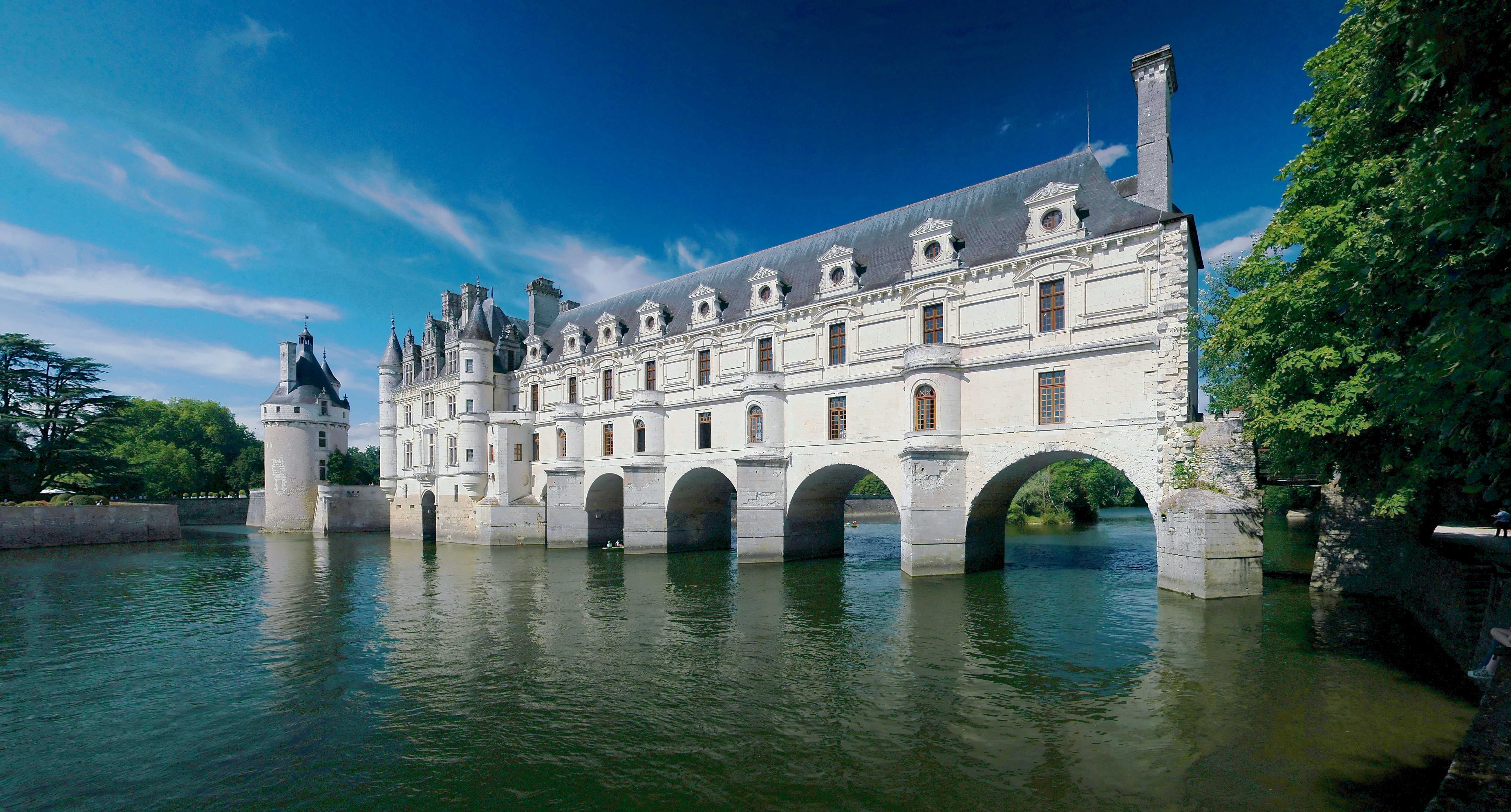
This was a famous and influential garden, originally planned by Diane de Poitiers,   the king’s mistress, the queen’s  rival. When the king, Henri II, died, Queen Catherine was able to wrest Chateau de Chenonceau  and its lovely gardens away from Diane.
The queen, Catherine de Medici was accused of poisoning people right and left, but possibly suffered from a bad press rather than the instincts of a serial murderer. She loved gardens, including the gardens at Chateau de Chenonceau and where she planted a potager. Catherine, (like the original design of the potager) was Italian--- a Medici.


The Medici’s, being upstart (in the eyes of older French aristocrats), made a great showing as patrons of the arts, and gardens. Catherine brought the family love of display (and gardens) with her when she married theFrench King, Henri II. (See an Italian vegetable garden http://www.lifeinitaly.com/garden/italians.asp .) The traditional Italian vegetable garden is laid out along classical lines in squares rectangles and triangles, separated by gravel paths. It is at once practical and elegant. No flowers except “medicinal “ones.  
 Catherine di Medici was famous for her “recipes”. Here is a bit of her vegetable garden at Chenounceau:

                            and here's another.

Curiously enough, that’s a castor bean growing, marked very properly as ricin- Ricinus communis (Castor bean). Quite poison.

 Hmmm…. Both Catherine and Louis seemed to have poisons growing in their potagers rather than “edible” plants. (You could eat the marigolds, and the herb growing which looks like sage… or possibly the gardeners are having their little joke?) Interesting! These gardens are both national treasurers--- historical sites---preserved--- my guess is the planting is historically accurate. It paid to keep a sharp eye on those royals!


So where are we with our potager? It has to be laid out geometrically, in a pleasing pattern, separated by gravel (or maybe decomposed granite) paths. We are growing vegetables, poisonous flowering plants....no, no this won't do. We have to find a harmless potager, such as the one above at Chateau Villandry. 
.Jean de Breton whose chateau it was, apparently quite straight forward—at least in his gardening. (He was the Controller –General for Francis I, not an easy master. (See Shellabarger’s novel The King’s Cavalier).

Now this innocent potager is going to be a little oversize for most of us, but could easily be copied on a small scale. Normally we don’t make a salad for 200 at dinner, don’t need 6 beds of 6 x 6 lettuce at a time.

 
The garden contains long slim beds of artichokes, maze patterns of red cabbage, beautiful ornamental (and edible kale) lots of peppers, celery, using the blocks of color created by the vegetable foliage in a decorative pattern, as well as having the geometry of the beds as a strong design element .

Those of us who have ripped up our lawns to grow vegetables in our efforts to be green and thereby annoyed our neighbors—may do well to consider a potager along the lines of Villandry as a working model. The vegetables would thrive, the irate neighbors subside.

Potagers are still fashionable, desirable and “green”.The Huntington Museum has just been left a massive bequest (around 100 million) by Frances Brody especially favoring the gardens.

According to James Folsom, director of the gardens, high-priority projects include “improving and modernizing” ....... and creating a “potager” or kitchen garden. (La Times 11/20/10 Home section).
High style! Frances, Catherine and Diane would have understood each other.

Next: English Kitchen Gardens


Friday, November 19, 2010

Catch-Up! Hummingbirds, butterflies, vegetable gardens


Here are the Monarch caterpillars stuffing themselves on the Mexican Milkweed (Asclepia incarnata). Had to make two trips to the nursery to pick up 3 more gallon cans of milkweed, bringing the amount of milkweed to about 15 plants. The caterpillars would have eaten more, given more. Not only will the Monarchs come, they'll eat you out of house and home. Every lady Monarch for miles around heard about the milkweed and hastened over. I never cease to be amazed when something works exactly as advertised.

The hummingbirds are migrating, recognizing the feeders in the same place they found them last year. The gold finches told their friends about the nyger seed in the backyard, and they ate 2 sockfuls in a week. The Gulf Fritillaries are still hatching from the Passion vines. Urban wildlife is persistent and smart!

We've been eating from our heavily composted vegetable garden for several weeks. The tomatoes ripened very late, due to the cold summer. The most successful varieties were San Diego and a September planting of San Francisco Fog which is still producing tomatoes. The Rainbow chard has been a constant delight (saute' finely chopped garlic, a bulb of fennel also finely chopped, in olive oil until translucent. Add the sliced chard just long enough to wilt it. Salt to taste.)

We grow a lot of things.It was a great year for Italian parsley--still going strong, a foot high, shaded by the tomatillo bush. The chives liked the shade of the tomatoes in the afternoon. The fennel grows abundantly and happily shaded by another tomato. Basil and peppers of course, like the full sun (good luck finding any this year!)

Vegetable gardeners, get the latest issue (Dec/Jan.) of  Organic Gardening magazine, as it has a remarkable organic, layered vegetable garden growing in L.A. We've composted, but this goes farther--it's a no dig garden, layered with 14 layers of various things. The garden "recipe" was developed for the Australian Outback, which is even less hospital to vegetable gardening than our semi-desert. The Layered Garden is on p. 46.

If you go to http://wwwsuperseeds.com/  you'll find an astonishing source of just about anything you could think of in vegetable seeds--including the hard to find baby purple artichoke, Violetto. Even more impressive is their selection of books-- many hard to find old ones at amazing prices. They carry the original book on layered gardening, the carry the original book on companion planting. (This makes sense, but never tried it- next on my list of plant experiments) 

Wednesday, November 3, 2010

More musings on the fabulous Fava bean


Everybody—pretty much---knows about the Irish Potato Famine being caused by a potato blight  (“Phytophthora infestans is an oomycete or water mold that causes the serious potato disease known as late blight or potato blight” W). During The Great Hunger one in eight Irish people died.


  roughly, a million) and another million immigrated to the U.S. all because of a one crop agriculture based on one kind of potato only. (Called Lumpen potatoes) Had they grown several different kinds, the Famine would not have occurred. Most of us know about the Famine, but the fact that it was based on only one kind of potato ( monoculture) is crucial. If a variety of different kinds had been planted-some would have survived. see                                             
 (from http://evolution.berkeley.edu/evolibrary/article/agriculture_02)S


Many of us ( with Irish genes)  know the English were not much help to the Irish at this time. (Queen Victoria, for one, was later accused of being actively opposed to the helping the starving Irish for economic reasons having to do with protecting English grain prices. Actually she gave them 25,000 lbs of her own money.She got angry with the Irish later on about something else entirely ---- spurning a memorial to Prince Albert.)

Victoria


But since the fava bean had been a staple in  N. Europe before the introduction of the potato in the late 16th c. to Ireland why did no one attempt replace the blighted  potato with the Fava Bean? 

 The mass migrations to this country would never have occurred ........

 If there is a moral to this story, and there are several (make up your own!) --- one is the simple non-inflammatory fact that Irish agriculture with its dependence on one crop suffers the same kind of fate as the giant Roman farms , the latifundia of  1 B.C through the period of Empire. The latifundia had problems with various grain blights that destroyed a whole year’s crop in no time.       This is a mosiac of Pestilence from a latifundia villa in Italy (Villa of Hamlet) She is holding grain in her left hand .                                         

Pestilence
  In this country, right now, we are having a terrible time with  Bee Die-off (Colony Collapse Disorder) in which the bees desert and abandon their hives. Apiculture as big agro-business has turned out to be yet another environmental disaster that seriously effects our food sources. Here are the bees being trucked off en mass to another location, taking their CCD with them.                                         
 
Small really is better! In Ireland during the time of the potato blight, a few small farms growing varied crops survived handily because their economy had never been based on a one crop system. The English had imported some small farmers from N. Europe ( Bavaria, as I remember) in an attempt to introduce  an example of better farming methods , rather in the spirit of Prince Charles  today at

The small varied crop farms never really caught on in the big Irish estates--- but those farmers went right on thriving and surviving. Betcha they were eating Fava
beans! See Marcella Hazan
     http://www.seasonalchef.com/recipe0506b.htm#Young Root-Vegetable Braise. She's one of the worlds great cooks.

Saturday, October 30, 2010

Two beautiful Beans -- Fava & Scarlet Runner Beans


What are we going to plant right now? Not many beans are cool season crops 
Fava  Beans- Vicia Faba
These two  beans you can plant in the fall are scarlet runner bean and fava (or broad bean). Some beans are low water, some are not. The most ancient ones were selected in arid climates like our own,  and  aren’t thirsty.

If you are going to grow vegetables in your back (or front)  yard , raised beds with lots of free compost from your municipal recycling program, and  a  gray water [i] system  is the way to go in So Cal.Otherwise using a lot of water to grow vegetables in your yard doesn’t make sense. Just go to the Farmer’s Market!

However, an informal grey water system can be as simple as recycling the water from one bathtub by using a sump pump, an open window and a hose to your raised bed. If you recycle the water from one tub, by saving all the shower and bath water that 2 people use, you’ll  harvest  enough water.

Scarlet Runner-(p. coccineus)
In Europe Haricot d'Espagne, haricot écarlate

Soo-oo, grey water system in place, we’re ready to consider--- our beans.)  Some of the easiest and most prolific (like Scarlet Runner Bean, p. coccineus) )  take a moderate amount of water. Being scarlet, it attracts hummingbirds.


 The Scarlet Runner( Nahuatl "ayocotl" or in Spanish "ayocote’) originated in Mexico, around 2000 years ago….remains were found in Tehuacan in the Valley of Tehuacan”) Semi-arid, and on the warm side with  6-8 dry months. . Maize was also grown here.. Tehuacan was notable for being the site where the remains were found of the oldest domesticated corn in the world, (up to 5,000 years B.C.).

Does this climate sound familiar? Scarlet Runners are often discussed as "tropical" but that's misleading as like many plants from arid regions of Mexico, runners follow the rain pattern.

You don’t want to eat these beans uncooked, as the Runner beans contain traces of the poisonous lectinPhytohaemagglutinin  which is destroyed in cooking.

 You can even eat the root as they do in Central America It’s a climber that can be used to create shade for something that won’t take full sun in summer when the beans are creating a scarlet curtain.. Chard, parsley, fennel, artichokes  and  any of the greens  might like the relief  from full sun.

Fava Beans
 
You might never have encountered a fava bean unless you are Italian or Middle Eastern. However you might easily have had them in falafel.

 Fava are native to North Africa and SW Asia (W) and they are very ancient (6.500 B.C )  and very easy to grow. They were a staple in N. Europe until displaced by the potato. 

 Fava means “broad” in Italian, and that’s another name for them.Italians are pretty passionate about their favas—favas can be harvested in spring if planted in the fall, and even the young leaves can be eaten like spinach. You can fry them, puree’ them, make bean paste out of them http://www.food.com/recipe/gabriel-s-sauteed-fava-beans-117520 )


The Arabs eat them for breakfast as Ful Medames as the breakfast dish for Ramadan served with pita bread and a fried egg. http://mideastfood.about.com/od/maindishes/r/fulmedames.htm

...and mad dogs and Englishman go out in the noonday sun...." 

Grow favas now:In mild climates such as Southern California… sow fava beans in the fall, and patiently wait 150-180 days later, for harvest in spring. Fava beans are a legume, and require a long, cool growing season....."

 Territorial Seeds carry the seed as Broad Windsor Bean and Harris Seed has it as “Broad Improved Long Pod  and Heirloom Seeds has them as Fava Beans http://www.heirloomseeds.com/beans.htm.

Grow them as you would green peas. 

Bird News : the gold finches are migrating south along the Cenral Coast. They'd appreciate a sockful of nyger seed. If you put out the seed you'll have lots--they tell their friends!

Note: 

Note: Susan Carpenter, columnist for the LA Times  who has been doing green projects for the last year at her home, evaluated the projects in terms of success and economy. Grey water came out on top.(Latimes.com/Sunday,10/17/2010).
2 from Beans, A History by Ken Albala, Berg, NYC,NY  2007


Monday, October 25, 2010

Butterfly Update--- Monarch's Food is Mexican Butterfly Bush (Asclepias_curassavica )


Monarchs feed on members of the milkweed family, and they love the Mexican Butterfly Weed--so much so that on a visit to local nurseries---all the Asclepias_curassavica in five gallon cans had stripped branches. ( I was there because they had eaten all the leaves  on the ones I had). The plants are not really damaged, as the leaves promptly grow back when the caterpillars go into their next stage of becoming butterflies. Meanwhile


don't hurt the caterpillars--they are not interested in anything but milkweed, and don't have anything to do with treated plants of  Asclepias_curassavica. Those will poison the caterpillars. Result: no Monarchs. These butterflies are a challenged species in So Cal where we keep cutting down the Eucalyptus groves where they gather.

Passionflower is the host for the Gulf Fritillary. (see blog for 7/19/10) which breeds and hatches earlier than the Monarch.The brightly colored caterpillar is toxic to birds. The passionflower vines have completely recovered from being the host plant for the Fritillaries.


I'm hoping the the Anise Swallowtail will take a fancy to the fennel planted especially to appeal to him. So far the fennel is flourishing madly (turns out to be delicious grilled) but no Swallowtail caterpillars so far. Stay tuned. If you plant the right plants they will come!  Just haven't got the right stuff for swallowtails--they really prefer wild anise to anything else.Picky, picky, picky!


Monday, October 18, 2010

Fabled Pomegranates: flowers attract hummingbirds

It is a low water, manageable, graceful plant. Good for you, fire safe, drought resistant and might even make your fortune. (See Resnick at LACMA below)
I’m probably preaching to the choir on this one, as most of us have had it drummed into our heads that pomegranate juice is really, really, really good for you.


 (The FDA is not so sure it’s that good for you.)


However, there is no doubt that it’s just the tree for our Central Coast gardens. If you didn’t do anything but grow it as an ornamental tree it would be worth it.
 There's one purely ornamental Dwarf Pomegranate, ) Punica granatum nana:


And three edible varieties of Punica granatum --- Wonderful, Eversweet and Angel Red. The first picture is of Wonderful, the second of Angel Red (both photos are from Monrovia Nursery http://www.monrovia.com) 

Having grown Wonderful, I can say—it is. Eversweet sounds ---well, sweet.   Angel Red is a new hybrid created by a young man who died at 23. It’s also a beautiful, early bearing tree.


The classic 16th c.  Italian Garden had to have a pomegranate tree—it’s in the directions! Italian gardeners may have forgotten why they had to have one, but the pomegranates’ roots reach deep into antiquity.

Pomegranates have been found in Egyptian tombs, at Jericho, and Babylon, grown in groves in India, Iran, and Transcaucasia dating back to 1000 BC. (W)

The scientific name Punica granatum is something of mishmash.  But interesting—one source translates it as “the apple of carthage” which ties it back to the Phoenicians, who were the earliest traders in the Mediterranean, and could have spread it around the whole ancient world.

Or could it be the “apple” that Adam and Eve found irresistible, or the apple that Paris awarded to Venus (see Trojan War) for her gift of the most beautiful woman in the world –Helen?


Venus persuading Helen 


Cranach The Judgement of Paris


Another source says it means “seeded apple” and avers it came over the Silk Road.

 Probably our treasure,  travelled both routes. The fruit has a long association with tombs (Egypt) and the Greeks had their Persephone with her 3 seeds (see The Greek Myths) :

Rossetti's Persephone


More 


recently, the pomegranate gets credit for another contribution to art.  LACMA has a whole new gallery--- the Resnick Gallery of Roccoco  and 18th c. art--- thanks to POM© the juice. The collection contains this wonderful portrait of Marie Antoinette 

Marie Antoinette by Le Brun
who should be holding a pomegranate, not a rose. Like Persephone the poor woman was destined for a nasty and premature  trip to the Underworld.

But we will end on a better note with a recipe for a Persian  Pomegranate Lentil Soup 


collected  by Peggy Trowbridge Filipone  which contains pomegranate juice,rice,lentils,herbs and raisins. See http://homecooking.about.com/od/soups/r/blss101.htm


Pomegranate and Lentil Soup


Note: Monrovia Nursery grows Wonderful and Angel Red, Armstrong Nurseries grows Eversweet.