Search This Blog

Powered By Blogger

Sunday, August 8, 2010

Confederate Rose Unmasked--- at Last, and a Splendid New Agave

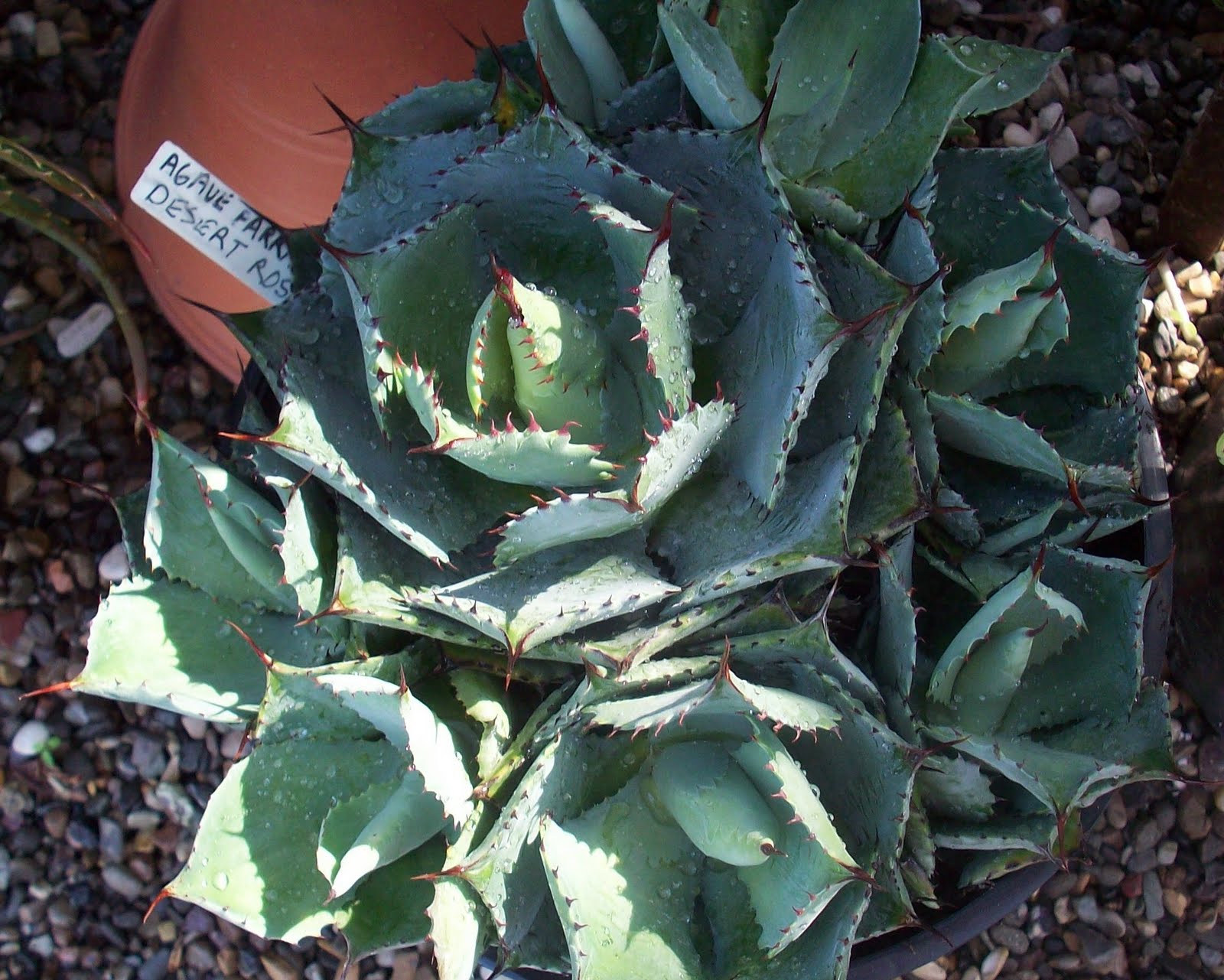
Agave parrasana (Desert Rose)
Agave parryii truncata
My Confederate Rose
Which twin has the Toni  ?  Still a mystery......                         

By the way, I must recommend a knock-out  mystery story to any who-dun- it fans.....it's called  Special Topics In Calamity Physics by Marisha Pessl    ( http://www.calamityphysics.com/main.htm)
One of the better things about a succulent garden is you have time to read mystery stories.
 This one is a winner--if you liked Holden Caulfield of  The Catcher in the Rye  you'll appreciate Blue Van Meer. The mystery itself is so well plotted , found myself going back and checking all the clues to be sure Pessl was playing fair.

Back to the mystery agave Confederate Rose. It really  is Agave parrasana Desert Rose, and you can find it at Terra Sol Nursery along with Tony the Agave Man who solved the mystery. He doesn't quite approve of the name Confederate Rose "I'm not sure it's a real name...." Probably isn't, but it does have an intriguing connotation Desert Rose lacks. (Why is it a Confederate Rose ? Were Southern girls prickly, or great survivors, or extremely fertile? )  Lacking Tony, you might be able to ID the agave by comparing the leaves very carefully. Truncata has some very fine stripes in its' leaves.

We've mentioned boutique agaves  (Debora Lee Baldwin's  term)  last January  and here's one that is resplendent---:  Agave lophantha v. Splendida . It's leaves are shiny, as though lacquered, it glows. Grows  grows 1' x 1.5', just right for a knock-out pot  (which this isn't). This  4" plastic pot  will not be it's home. Time to consult  Debra Lee Baldwin  in her book on Container Gardens, for the Perfect Pot..

Sunday, August 1, 2010

An extraordinary garden in Ojai and a recipe for Passion Fruit Mousse

SUCCULENT GARDEN IN OJAI- This is one of the more remarkable gardens around.The whole garden is about an acre, covered with live oaks, on the edge of a ravine. The gardener has managed to blend an astonishing array of plants (roses, Peruvian lilies, poppies, day lilies on one side of a path (in the sun) culminating in this triangular succulent garden under an oak, in semi-shade. (One reason the succulents look so lush is the shade).The top of the triangle is the wall of the house containing two doors.
The succulents are combined with a lavish hand.
The bright green is E. agavoides, the furry one bottom right is E. v. Doris Taylor.(Woolly Rose)

In this bit of the garden,:far left is Pachphylum amethystinum
Next is e. nodulosa , a beautiful and subtle echeveria whose coloring doesn't show up well in the group photo, (taken in the late afternoon.) In the close-up you can see its fine fuchsia lines like painted china.
 By the way, echeverias are named for an 18th c.. botanist Atanasio Echeverría y Godoy who set out with two other naturalist to catalogue all the flora and fauna of Mexico. This worthwhile endeavor was subverted by Europe's endless wars during the period.

 The  big blue rosettes are E. sp of Hens and Chicks and are hard to beat for dramatic display. Prolific and un-fussy. To the right is e. nodula also called Painted Echveria.   Hens & Chicks turn up in different colors  throught the design.                                                                                   
Echeveria sp.


To the top left of this arrangement is E. agavoides v. Maria (photo from San Marcos Growers)


Presiding over this exuberant  succulent garden is a terra cotta statue of the benevolent Hindu deity, Ganesha, the guardian of thresholds and remover of obstacles.

Ganesha

Assuming you are going to race out to get your passion flower vine so you can have lovely orange butterflies( Gulf Fritillaries) as we suggested last week, an added bonus is ---you can  eat the fruit of the passion flower as long as you are careful to buy passiflora incarnata (and the butterflies will like it fine) --- or maracujá (P. edulis) , the fruit of  which you can buy  at the grocery store in SoCal. The blossoms are quite similar, and butterflies like both vines.
                                                 maracujá (P. edulis)
                                                                                                    
                                                             p. incarnita

This recipe looks like something dramatic to do with the fruit (which the vines produce prolifically in our climate.)

Café Brasil's passion fruit mousse (Mousse de Maracuja) L.A Times 7/22/10 - copyright LA Times (means you can't put it in a cookbook and sell the book.)  Total time: 25 minutes, plus chilling time.Servings: 6
Note: Adapted from Café Brasil in Los Angeles. Superfine sugar is also referred to as baker's sugar and can be found at well-stocked markets and cooking and baking supply stores. Fresh passion fruit might sometimes be hard to find due to seasonality and related availability; unsweetened passion fruit concentrate is a great substitute. Unsweetened passion fruit concentrate can be found at select cooking and Brazilian markets, as well as at well-stocked Latin sections in select supermarkets. It is also available online.
1/2 cup strained fresh passion fruit juice, from about 14 passion fruits or 1/2 cup unsweetened concentrate, divided
1/2 envelope unflavored gelatin powder, about 1 1/8 teaspoons
1/2 cup plus 2 tablespoons evaporated milk
1/2 cup superfine sugar, divided
4 egg whites
Pinch of salt
Fresh passion fruit seeds, for garnish, optional

1. If using fresh fruit, halve the fruit and strain the pulp through a fine sieve, rubbing to remove the pulp from the seeds. Wash the seeds in water, then dry on a paper towel. They will be used to garnish the mousse.
2. Place 2 tablespoons purée or juice concentrate in a small, nonreactive heavy-bottom saucepan and sprinkle over the gelatin to moisten. Heat the mixture over medium-low heat, stirring, just until the gelatin is dissolved and no lumps remain. Remove from heat and place the mixture in a medium bowl.

3. Add the remaining juice to the bowl and stir to combine. Add the evaporated milk and one-fourth cup sugar and stir until dissolved. Place the mixture over an ice bath and stir until chilled and slightly thickened. Remove from the ice bath.

4. In a medium bowl, beat the egg whites and salt to soft peaks. With the mixer running, gradually add the remaining one-fourth cup sugar and beat until the meringue is stiff and glossy.

5. Add a large spoonful of the egg white mixture to the chilled passion fruit mixture and gently stir until thoroughly combined. Fold in the remaining meringue, one-third at a time, careful not to over-mix.

6. Spoon the mousse into individual margarita or stemmed glasses and chill. Sprinkle with the optional reserved passion fruit seeds before serving.
Bon Appe'tit!


Saturday, July 24, 2010

Agave parryii, or what?


This is the  latest treasure added to the out of control succulent collection. It was labelled Confederate Rose.
What is it? Agave  Parryii, - - also called Mescal Agave , Artichoke Agave, Desert Rose, Confederate Rose. There seems to be a lot of confusion about this plant. What is quite certain is that it’s, from the desert, and some plants seem to sucker easily like this one, and others don’t at all. They clump.


Agave Parryii originates in New Mexico, Arizona and N. Mexico. This possibly explains the some of the confusion—the different locations may have produced slightly dissimilar plants. However The Mescal Agave is not the same agave but A. americana , known in Mexico as maguey,from which is made mezcal the a smoky liquor, generally drunk neat. ( If it has with the larva worm in it, you have gotten the inferior version made for dumb gringos.) Most mezcal comes from Oaxaca, where it is appreciated, and considered good for hypertension, diabetes and will jump starting your  sex life.

 In N. Mexico, you throw it down before breakfast. However, it won’t look as good in a pot as A. Parryii:


Artichoke Agave is A Parryii v. var. huachucensis , according to the very reliable San Marcos Growers( www.smgrowers.com)” This agave from South-eastern Arizona south to Chihuahua ….forms suckers. Individual plants are 18 inches to 2 feet tall by 2 to 3 feet wide with the sucker growth produces dense clumps.”


And is often confused with A. parryi v. truncata which it is not !
This is:
See---shorter, fatter leaves. This variety has lots of sports.
All A Parryii varieties are are monocarpic, meaning they bloom once in the life of the plant. The parent plant dies, hopefully having left many sucker off- spring behind.

Confederate Rose is possibly Agave potatorum

Photo  from The Tropic Center.

And the Desert Rose may be Agave parrasana
 Origin: Mountainous areas of Coahuila (Mexico) higher than 4000 feet in elevation (1200 m).
Growth Habits: Clumping succulent rosette, up to 2 feet in diameter each (60 cm)..


Photo from Xeric World (good site)   http://www.xericworld.com/forums/home.php
Now, are you  inspired to go get one of each?

Monday, July 19, 2010

Butterflies on the Central Coast and a nifty cold soup for the hot weather

One of the nicest things that has happened in July is suddenly- a lot of butterflies! This one is a Buckeye, (Jununia coenia) and the spots on his wings are to scare young (dumb?) birds into thinking the spots are eyes. Buckeyes aren't fussy eaters, but they are very territorial. (I think this means "stay off my snapdragon" since they like snapdragons, veronica, and various weeds.) Snap dragons are a host plant --they both imbibe the nectar and lay their eggs on the host.

Host plants are crucial. There used to be lots of Anise Swallowtails around this neighborhood. They bred on the wild fennel which is everywhere along the roadsides in summer. But we have become so cultivated in town, there's no wild fennel to breed on.So, Anise Swallowtails have simply disappeared . My neighbor's   conscientious gardener removed the last patch of wild fennel from a nice messy spot at the back of her lawn .Haven't seen a swallowtail since.
Trying to grow wild fennel is not as easy as you'd think......been strewing fennel seed here and  there,but so far-- no fennel. I suspect it's like poppies--- you must get the seeds in right after the first rain

However, I did import two host plants for the Gulf Fritillary who love passion flowers,and --- it worked. The garden is brilliant with these orange beauties.

I don't know where they came from, or how the message got out, but the GF's have raised 2 seasons worth of children on a rather scruffy pair of passion flower vines. One is the blue passion flower which the butterfly sseems to  to prefer, but she'll make do with the scarlet perfectly happily.(Passiflora coccinea)


Blue Passionflower This  has been the favorite for eggs---the pupae dangle and hatch before your eyes. Quite miraculous no matter how often it happens. We don't have just a couple of GF's--we have lots, so if you want some of your own hurry to your preferred plant  nursery and get a passion vine.

Thanks to a neighbor's giant broccoli (which hasn't produced any broccoli, but is 4 feet tall) we have Cabbage Whites. These are considered an Invasive Species in some circles, as the host plants are cabbage family crops. However, since neither broccoli or cabbage is high on my list of preferred foods (they are healthy, but so are ice cold showers) I'm delighted to have Cabbage Whites decorating my rose garden (note: rose garden entirely on grey water.) So for your own Cabbage Whites, try some Ornamental Kale.
Pretty, and you don't have to feel guilty about not eating it.

If you grow lantana--and it comes in yellow, white, and lavender for starters--- you will find yourself the happy possessor of the host plant for the Orange Sulphur--that one usually sees looking like this:
 but he's full of surprises. His topside looks quite different.


  Lantana is not only a host plant, it's very water thrifty, can be pruned hard and used as a ground cover, or allowed to sprawl and become a big mound of flowers.

If you live on the Central coast, chances are you have Monarchs. If not--you can buy some!http://www.butterflyreleases.com/?gclid=CIT0i-XL-KICFSP5iAodYykfhQ

Here's the female Monarch.


And the male Monarch

We are  lucky enough to have both sexes  in the garden. Apparently they like purple flowers--lavender, Mexican Sage, Society Garlic, agapanthus. All low water. A sensible as well as spectacular  being.  Butterflies love puddles and as well, will drink nectar from butterfly feeders.                                                           
   All photos from W Commons

Here's the cold soup recipe: (LA Times 7/15/10) Servings: 6 to 8           86 cal a serving
Note: Adapted from a recipe by Teresa Fanucchi in "A Place at the Table"
2 large leeks, white and pale green parts only
2 tablespoons olive oil
2 pounds yellow crookneck squash or golden zucchini, chopped (Or green zucchini of which we always have TOO MUCH)
1 quart vegetable broth, more if desired
Salt and white pepper
2 tablespoons fresh dill, chopped, plus a little more for garnish
1/2 cup plain yogurt or sour cream
1 teaspoon lemon zest

1. Clean the leeks. Coarsely chop the white and pale green parts of leeks. Submerge the leeks in water to remove any sandy soil. Rinse well in a colander, and shake to remove any moisture.

2. In a medium soup pot, heat the olive oil over medium heat. Add the leeks and cook until softened, about 5 minutes, stirring frequently. Add the squash and broth. Season lightly with one-fourth teaspoon salt and one-eighth teaspoon white pepper. Stir in the fresh dill. Bring the soup to a boil, then reduce the heat to a very gentle simmer and continue cooking, with the lid ajar, until the vegetables are tender, about 20 minutes.

3. Remove from heat and set the soup aside for about 30 minutes to give the flavors time to marry. Purée the soup using a blender (this will need to be done in batches, filling the blender no more than two-thirds full, and being very careful if the liquid is still hot). The soup can also be blended using an immersion blender. Add additional broth if desired to thin the soup to preferred thickness.
4.Transfer the soup to a covered storage container and refrigerate until chilled, at least 3 hours, preferably overnight. This makes about 6 cups soup.
5. In a small bowl, combine the yogurt with the lemon zest and a pinch of salt. Serve each bowl of soup with a dollop of the yogurt mixture.

Friday, July 9, 2010

Cycads and other delights--- Miss Jersey Giant and avocado gazpacho


The Cycad Garden
Lotusland

That mislabeled plant you bought at the Big Box is not a sago palm at all.
It’s a cycad with an astonishing and impressive history.


cycad fossil  (from W commons)

 Cycads were around with the dinosaurs---and were the food of herbivore dinosaurs (ex. Triceratops .) Somehow the cycads survived The Great Die Off that killed the dinosaurs, and so many other creatures. (Latest theory for the GDO is an enormous meteorite (6-10 miles wide) that created the Chicxulub crater in Yucatan, Mexico which either obscured the sun with dust, or sulphur dioxide gas which shut down photosynthesis, cooled the planet , starved the herbivores, and then the meat-eaters (T.rex) (See http://news.nationalgeographic.com/news/)

 
A cycad at Lotusland

This means your “sago Palm” is can do nicely without full sunlight, though many cycads  love the sun.. The most remarkable collection of cycads anywhere are  here in SoCal –not on the back lot of Universal Studios as you might expect along with Jurassic Park and the T. Rex--- but at Lotusland (www.lotusland.org).

Mme. Gana Walska loved the curious, and the grotesque as well as the beautiful. Cycads are all of the above, as well as being drought resistant, slow growing and good companions for succulents.The cycad collection at Lotusland was acquired by Mme. by selling a million dollars worth of her jewels at Sotheby’s-- so don’t miss it!
 
 
Local news :we are exchanging apples from the amazing " bears 2 crops a year " apple tree for eggs from the Urban Farm. Our favorite Bad Girl --Miss Jersey Giant in the white feathers-- turns out to be a great producer of lovely cream colored eggs. Of course, the Urbane Farmer has to be swift to gather them before she eats them. She's still a Bad Girl....
 
We've also gotten Haas avocados from the Urbane Farmer  and found a recipe for avocado gazpacho in the LA Times for June 24th in the Food section.
Servings: 4
1 cup packed fresh bread crumbs
Water for soaking the bread crumbs
2 cloves garlic
1 pound ripe avocados (about 3), peeled and chopped
1/3 cup fresh lemon juice
1/4 cup extra-virgin olive oil
11/2 teaspoons salt
Chopped green onion, for garnish
Chopped tomato, for garnish
Chopped cilantro (optional), for garnish
1. Soak the bread crumbs in water to cover until softened. Drain off the excess water (reserve the water to thin the soup if desired) and place the bread in a blender with the garlic. Purée until smooth. Add the avocados and lemon juice and purée. Blend in the oil and salt. Thin the soup, as desired, with the reserved water.
2. Serve the gazpacho at room temperature or chilled. Garnish each serving with chopped green onion, tomato and cilantro.
Each of 4 servings: 315 calories; Thank you LA Times!

Saturday, July 3, 2010

What's a Succulent Collector to do? And anti-mold recipes

Collections are the very devil to deal with. The laws of design demand mass effects, repetitions--- but what about those of us who can't resist a succulent we don't have? How to deal with 79 different little darlings?

Mine spent two months sitting under a tree in the backyard looking unloved, as they were displaced when we painted the house. The one place they could possibly find a new home is  a narrow (1.75. feet) strip of dirt, with a west facing exposure, bounded by a sidewalk on one side, and the house wall on the other. Many houses have a strip of dirt like this and most plants don't like it. Decided the only way to proceed was to leave them in pots, as some of them need almost no water (barrel cactus, mammillaria and some agaves), where as others, like the sedums ,need to be watered about once a week if they are not going to look stressed.


This one--a small African Euphorbia--seems to thrive almost anywhere with or without water, and goes on happily producing little rosettes. It's in a 3" pot.


These all want to be watered once a week to look happy. The Blue Elf has turned purple because it needs more water. The bright green Mexican sedum has been getting enough water, but the pink sedum is stressed. The theory is to put the pots with the same water requirements together, then arrange again within that parameter. Sounds like a plan.

To catch up on the local news-the Urbane Farmer has been struggling with mold on his zucchini  (it came over the wall from a neighbor's neglected garden patch.) He first got some sulphur dust but when he read the label he decided it was too toxic. Soooo...he got on the net and found a totally non-toxic recipe: water, a little olive oil and a pinch of baking soda . It worked. It should work on zinnias and dahlias as well as the squash. Spray it on with a spray bottle. Add that to your collection of non-toxic sprays  along with milk to get rid of black spot on roses. 

Another success---we have new  ocean friendly gardens with  parterres for our dwarf citrus. Each terrace covered with a thick layer of compost (free from the city) with paths of decomposed granite which will slow down any water trying to run-off.